Advanced Growth Hacking Strategies Beyond Basic Ppc

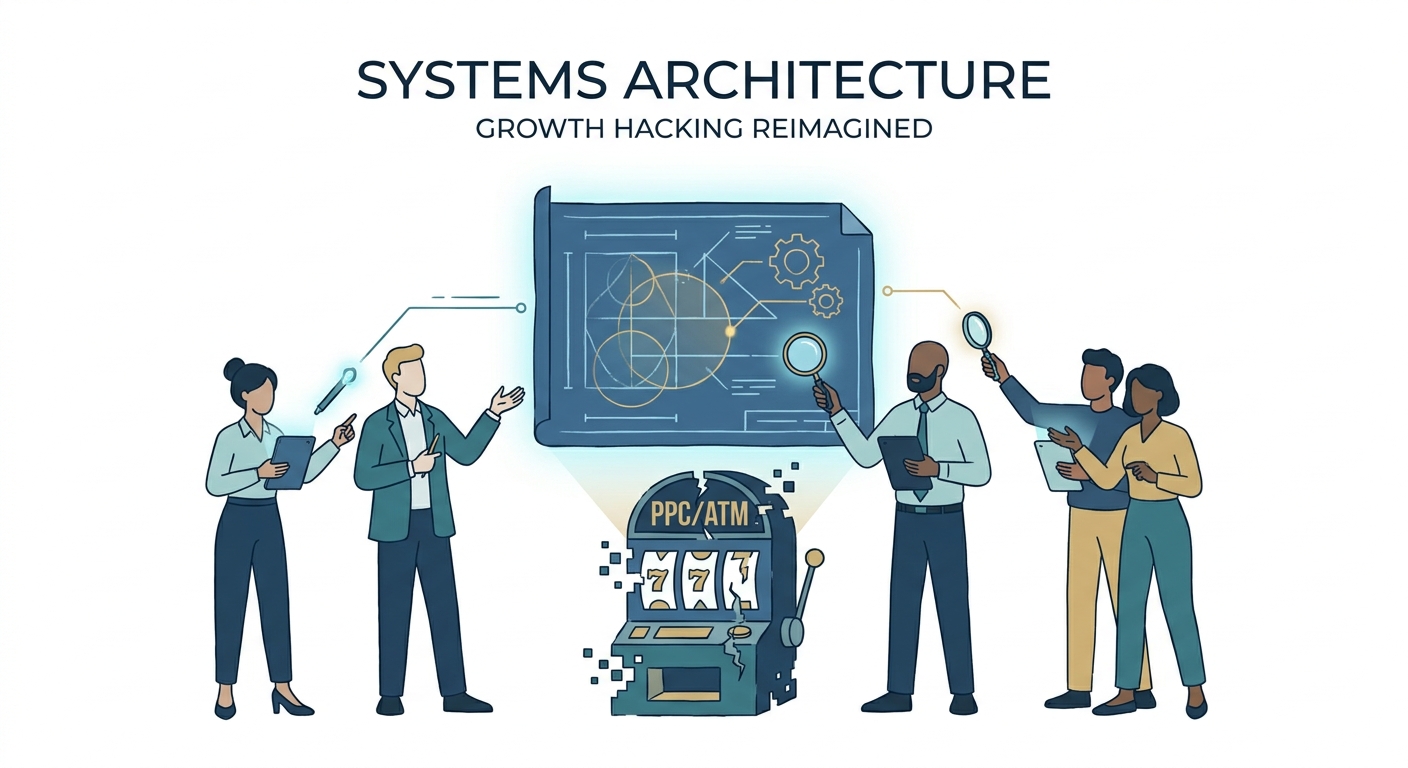
Growth hacking in 2026 isn't about finding a back-door exploit in an algorithm or "gaming" a search engine. Those days are long gone. The game has shifted. It’s no longer about being a digital landlord—renting expensive, temperamental space on platforms that change their rules every time you get comfortable.
It’s about becoming a systems architect.
If your growth strategy still lives and dies by your PPC spend, you aren't growing. You’re just a glorified ATM for tech giants. You’re subsidizing their quarterly earnings while praying your own CAC doesn't spike. Modern growth is a product-engineering discipline. It’s about building compounding, autonomous loops directly into the user experience. We’re moving away from manual campaign management and into the era of agentic orchestration.
The Death of the "Hacker" Mindset: Why PPC is a Trap in 2026
The "hacker" mindset of 2015—that scrappy, desperate hunt for quick wins—is a liability today. PPC has become a commodity. Every competitor with a bank account can run the same ads, bid on the same keywords, and target the same demographics.
The math is simple, but brutal: your budget is finite, but your CAC is effectively infinite because it’s pegged to the highest bidder in an auction you don't control.
According to Gartner AI Agent Projections, manual ad management is being steamrolled by autonomous systems that tweak bids, copy, and targeting in milliseconds. If you’re still manually adjusting ad sets, you’re trying to win a knife fight against a supercomputer. The only way to win is to stop playing the auction game entirely. Focus on "owned" growth. When you rely on PPC, growth dies the moment your credit card stops processing. When you build a growth loop, every new user creates a baseline for the next. Your CAC drops over time, fueled by network effects and genuine advocacy.
What is Precision Growth? (Beyond the "Hack")
Precision growth is the scientific middle finger to the "HiPPO" (Highest Paid Person’s Opinion) approach. It stops treating users like wallets to be picked and starts treating every interaction as a vital data point. We’re moving toward a model where hypotheses are born from deep behavioral analytics, not a gut feeling in a boardroom.
This "Growth Engineering Loop" ensures every experiment—whether it’s a sign-up flow tweak or a new email trigger—is validated for statistical significance before it hits the gas. You aren’t guessing what works. You’re engineering the environment until the data forces a win.
How to Architect the Full Lifecycle
The most common mistake? Teams dump 90% of their energy into the "A" in the Pirate Metrics Framework. They obsess over acquisition and leave the rest to rot. But in 2026, the most potent growth engine isn't an ad. It's your onboarding flow. A deliberate allocation model like the 70-20-10 rule for advertising budgets forces that same discipline onto spend itself, so "acquisition" doesn't quietly eat the budget meant for activation and experimentation.
Activation is the moment the user actually "gets it." If your onboarding is just a slide deck of features nobody reads, you’re bleeding revenue at the top of the pipe. An engineered activation flow forces the user to perform a "core action" that delivers immediate value. By using a Data-Driven Content Strategy, you ensure every piece of content is context-aware, guiding the user from "just looking" to "power user." When you optimize for activation, you skyrocket your LTV. That gives you the breathing room to outspend competitors on acquisition, not because you have more money, but because your unit economics are simply superior. For a broader survey of expansion levers beyond the acquisition funnel alone — freemium/premium tradeoffs, growth hacking fundamentals, and content scaling — see Unlocking Growth: Strategies for Rapid Business Expansion.
Engineering Viral Loops: Can You Build Growth Into Your Product?
The difference between linear growth and exponential growth is the difference between buying traffic and building a product that people naturally want to share. As explored in the Science of Viral Loops, behavioral psychology is clear: users share products when it makes them look smarter, faster, or more efficient.
Stop looking for "referral programs" that offer $10 for a sign-up. That’s amateur hour. Instead, build collaborative features. If a user’s experience improves the more they invite colleagues—think shared dashboards, collaborative workspaces, or multi-user project boards—the product grows itself. This is internal distribution. It’s the only way to achieve truly sustainable, exponential scale.
The Rise of Agentic Orchestration: Are You Ready for AI-Driven Growth?
Imagine a "24/7 Optimizer." This is an autonomous AI agent that manages your entire user lifecycle. It doesn't just blast out a generic newsletter. It monitors user behavior in real-time. If a user stalls at step three of a project, the agent doesn't send a "we miss you" email. It triggers a surgical, personalized nudge: "I noticed you hit a snag with the integration; here is a 30-second video on how to solve that specific error."
This is agentic orchestration. The agent shifts landing page copy to match the user's referral source, re-segments them based on feature usage, and optimizes the onboarding sequence—all while you sleep. The growth engineer isn't pulling levers anymore; you’re the architect designing the machine that pulls them for you.
Where Does "Strategic Integrity" Fit in Your Growth Stack?
We need to address the elephant in the room: growth at all costs. The digital landscape is a graveyard of companies that used "dark patterns"—deceptive UI, hidden subscriptions, and forced data harvesting—to inflate numbers. The $2.5B FTC settlement is a blunt reminder that aggressive, non-transparent tactics aren't just unethical; they’re an existential threat.
Strategic integrity is the ultimate growth hack. When you treat users with respect, you build brand equity that compound interest can't touch. LTV is destroyed by friction and deception. If your growth is built on tricking the user, your churn rate will eventually eat your acquisition rate alive. Build for the long term. Protect your reputation. Your growth will be more resilient to regulatory shifts and market volatility than any "hack" could ever promise.
How Do You Build a T-Shaped Growth Team?
The title of "Marketer" is dying. The new role is "Growth Engineer." You need a team with a T-shaped skill set: a broad understanding of the entire user lifecycle, anchored by deep, specialized technical expertise.
Your team needs to understand API integrations—the glue that connects your CRM to your product and your AI agents. They need a solid grasp of behavioral psychology to understand why users convert. Most importantly, they need to be fluent in predictive analytics. You don't need a team of 50 people. You need five people who know how to build systems that automate the work of 50.
Conclusion: Building an Intelligent, Value-Driven System
Growth hacking isn't about the "how" anymore. It’s about the "system." If you’re still trapped in the PPC cycle, you’re losing a war against rising costs and dwindling attention spans. The future belongs to those who view growth as an engineering problem—one solved through product-led mechanics, agentic orchestration, and a relentless focus on the user lifecycle.
If you’re ready to stop renting your growth and start building a system that compounds, GrackerAI is a self-serve AEO/GEO platform that tracks your brand's citations across ChatGPT, Perplexity, Claude, and Gemini, measures your AI search visibility, and identifies which sources these engines cite — so you can see and improve where you stand, rather than outsourcing it to an agency. The tools are here. Do you have the discipline to use them? For a practical walkthrough of building that system — growth stack, GEO, first-party data, and the human-in-the-loop model — see effective campaign strategies for business growth.
Frequently Asked Questions
Is growth hacking still relevant in 2026, or is it just marketing?
Growth hacking is more relevant than ever, but the definition has shifted. It’s no longer about finding platform loopholes; it’s a rigorous discipline of systems engineering and product optimization that replaces traditional, manual marketing.
How does AI change the role of a growth hacker?
AI shifts the growth hacker’s role from "campaign executor" to "orchestrator." Instead of manually managing ad sets, growth hackers now design, deploy, and monitor autonomous agents that run continuous, data-driven experiments across the entire user lifecycle.
What is the difference between PPC and Growth Hacking?
PPC is a "rented" traffic model that stops providing value the moment you stop paying. Growth hacking is an "owned" model; it involves engineering viral loops and product-led features that generate compounding traffic and retention organically.
How do I start growth hacking if I don't have a technical team?
You don't need a massive engineering department to start. Focus on "low-code" automation tools and behavioral psychology. Start by auditing your product’s onboarding flow to ensure users reach their "Aha!" moment faster, which is the highest-leverage growth activity you can perform.
![10 Best Local Rank Tracker Tools: In-Depth Comparison Guide [2025]](https://cdn.pseo.one/6abcb68a626591c40e1c8aa6/687e1c1ef6fe799d288518df/68809c373eb8562bcf68975d/10-best-local-rank-tracker-tools-comparison-guide/feature-image.jpg)