AI Visibility Intelligence · AI Monitoring

Know what AI tells your buyers about you. As it happens.

Your buyers ask ChatGPT, Perplexity, Claude and five other engines which product to choose. Those answers build the shortlist before anyone talks to sales, and you never get to see them. GrackerAI runs your prompts across all eight engines, reads every answer in full, and tells you the moment your name slips.

No credit card required. First monitors run in about a minute.

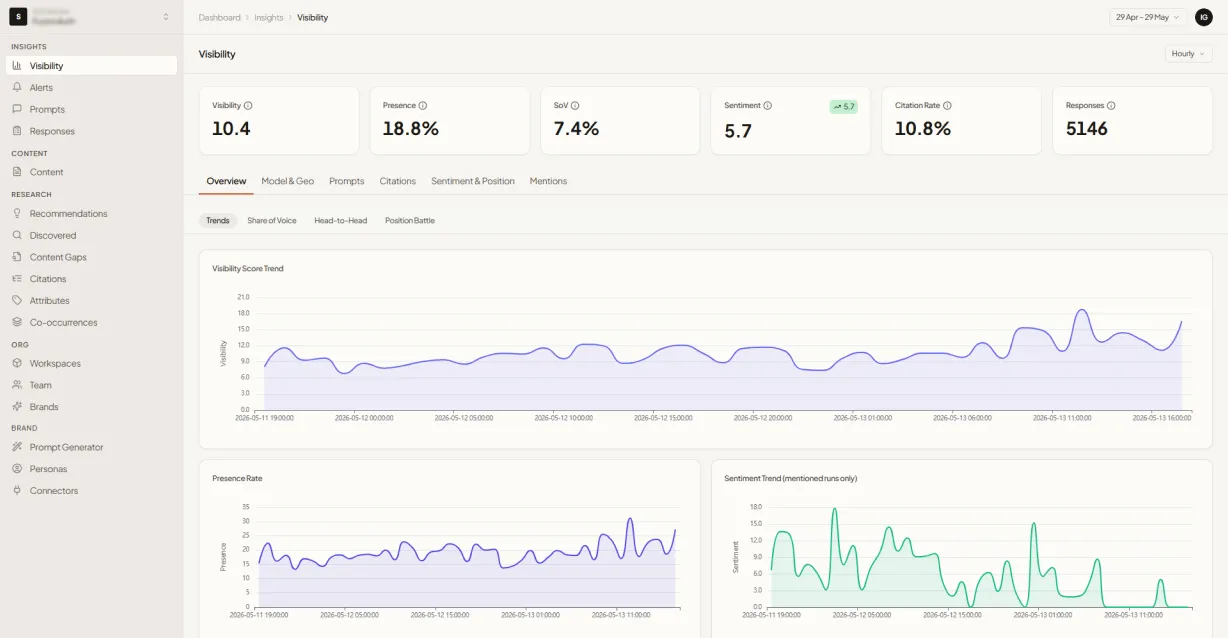
GrackerAI dashboard showing AEO and GEO citation tracking across ChatGPT, Perplexity, Claude, and Gemini
Search was something you could check. AI answers are not.

When a buyer asks AI which tool to pick, you are either in the answer or you are losing the deal you never saw.

A Google ranking sits still long enough to look at. An AI answer is written fresh for each person, pulls from sources you did not choose, and hands back a recommendation instead of a page of links. If your name is missing, no rankings report will tell you. The first sign is a quiet quarter that nobody can explain.

The problem

You cannot see the conversation

Every answer happens inside a private chat. Without something reading those answers for you, your most influential sales channel is a room you are not allowed into.

The delay

You find out months too late

By the time a drop in AI visibility reaches your pipeline numbers, the competitor who was watching has already banked a quarter of citations you now have to win back.

The stakes

Buyers trust the answer

People treat an AI recommendation as advice, not an ad. When it names a competitor and not you, that trust transfers to them, often before you are even on the list.

Good monitoring stays quiet until something changes. Then it tells you which engine, which buyer, which market, and what moved.

How a monitor run works

Five steps turn one question into a number you can trust

A monitor is not a keyword lookup. It asks a real buyer question, the way a buyer would ask it, then takes the answer apart. Here is the path every run follows before anything reaches your dashboard.

Ask

Send your prompt to the engine as a genuine buyer query.

Spread

Repeat across 8 engines, by persona and by region.

Capture

Store the whole answer word for word, not a summary.

Read

Pull six signals out of every answer automatically.

Compare

Check against history and alert you if something moved.

One prompt goes in. A stable, checked, comparable result comes out, every cycle.

The hard part we solved

The challenge is not asking a question once. It is asking it well, thousands of times a day, across engines that were never built to be measured. Most of them have no monitoring API, so we query them through the same surfaces a real person uses, while handling rate limits and session context so the answers stay representative.

The deeper problem is that language models are non-deterministic. Plainly put, ask the same question twice and the wording, the order of brands, even which sources get named can change. A single answer is closer to one response in a poll than a fact. So we run each prompt many times and combine the results. When your dashboard says you moved from second to fourth, it means the pattern shifted, not that one sample happened to wobble.

Coverage

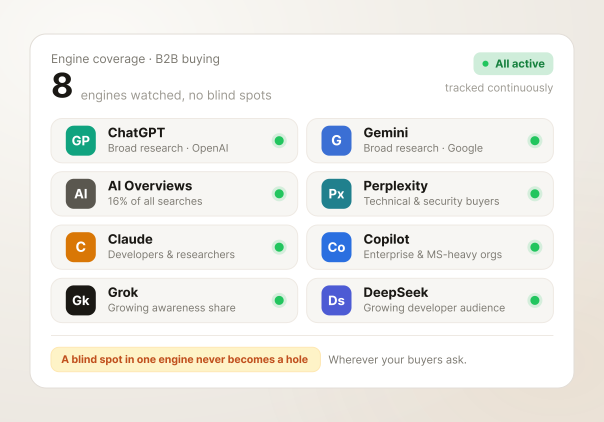
Eight engines, because your buyers do not all use the same one

Most tools watch ChatGPT, maybe Perplexity, and call it done. Your buyers are not that tidy. A security researcher lives in Claude. An enterprise team defaults to Copilot. A developer audience leans on Grok and DeepSeek. A gap in any one of those is a gap in what you know.

GrackerAI tracks all eight engines that shape B2B buying, so a blind spot in one place never quietly becomes a hole in your strategy.

  • Broad research engines: ChatGPT, Gemini, Google AI Overviews
  • Technical and security audiences: Perplexity, Claude
  • Enterprise and emerging: Copilot, Grok, DeepSeek
Diagram showing all eight AI engines GrackerAI monitors: ChatGPT, Gemini, Google AI Overviews, Perplexity, Claude, Copilot, Grok, and DeepSeek
Why one prompt is never one answer

A single question fans out into hundreds of real answers

The same product looks different depending on who is asking and where they are. So one prompt is not one check. It multiplies across every engine, every buyer persona, and every market you care about, and each combination gets captured on its own.

1 prompt "Best SSO for product-led growth"
engines ChatGPT, Claude, Perplexity and 5 more
personas CISO, engineer, analyst, buyer
regions Country and city level
answers captured each one read and scored

And because every answer is sampled more than once, the real number behind the scenes is larger still.

The hard part we solved

Running that many queries on a schedule, inside each engine's limits, without the answers degrading, is a logistics problem most tools avoid by simply checking less. We built the queue and sampling system so coverage stays wide and the data stays fresh, rather than trading one for the other.

What we read from every answer

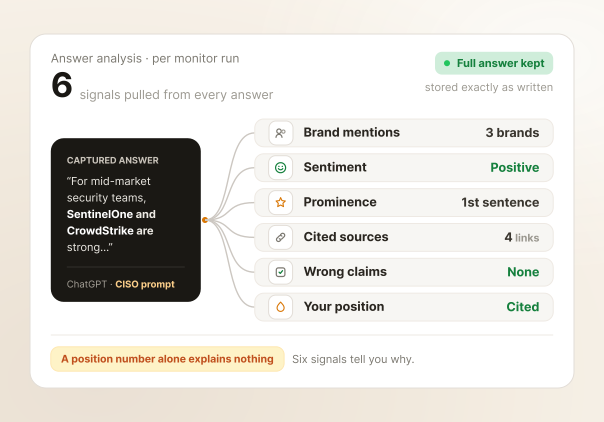
Six signals, because a position number explains nothing on its own

Diagram showing the six signals GrackerAI extracts from every AI answer: full response, brand mentions, sentiment, cited sources, prominence, and wrong claims

Knowing you ranked second tells you almost nothing useful. Were you praised or hedged? Which source convinced the model? Did it get a fact wrong? So every time a monitor runs, we keep the full answer and pull six things out of it that actually explain your visibility.

  • The complete answer, stored exactly as written
  • Brand mentions, yours and every competitor named with you
  • Sentiment, from warm recommendation to quiet caution
  • Cited sources, every link the engine leaned on
  • Prominence, first sentence or buried footnote
  • Wrong claims about you, flagged for review

The hard part we solved

Reading the answer is its own challenge. The text is ordinary prose, so the system has to recognise your brand even when it is misspelled, shortened, or buried inside a sentence about something else. It tells a real mention apart from a word that just happens to match, links each competitor to the right entity, and judges tone the way a careful reader would. That is the gap between counting a word and understanding a sentence.

Precision

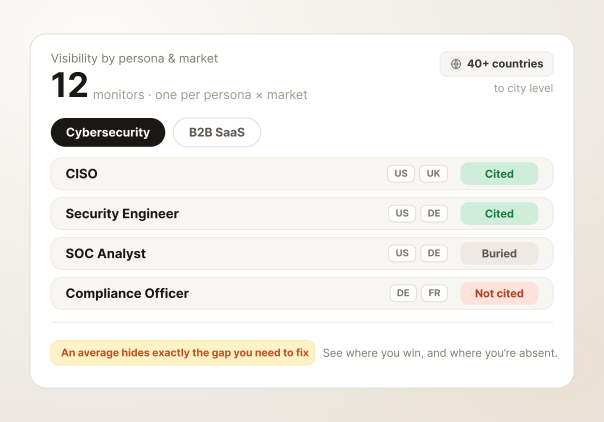
A CISO and a SOC analyst are not the same buyer

Illustration showing separate monitor results for CISO, security engineer, and SOC analyst personas across different regions

Ask "best DLP tools" as a CISO and you get one set of names. Ask as a hands-on analyst, or from Germany instead of the US, and the list changes. An average across all of them hides exactly the gap you need to fix.

So GrackerAI runs separate monitors for each persona and each market, across 40 countries and more, down to city level. You see precisely which audiences an engine shows you to, and which ones a competitor owns.

  • A monitor per persona, not one blended score
  • Country and city targeting for local campaigns
  • Clear view of where you win and where you are absent
Accuracy

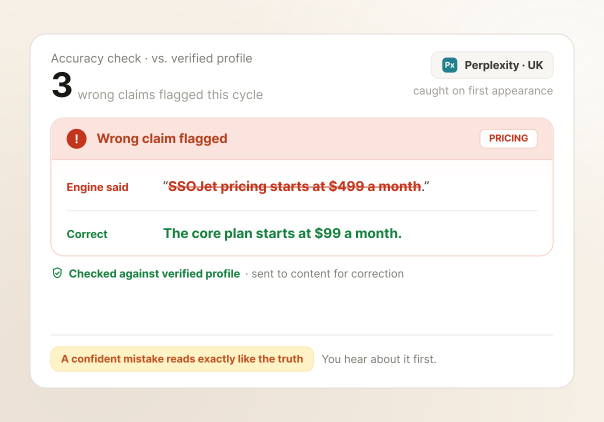
When an AI gets a fact wrong about you, you hear about it first

Illustration showing an AI claim being checked against a verified product profile, with wrong pricing flagged and the correction shown side by side

Engines invent things. Wrong pricing, a feature you do not offer, a rival's capability credited to you, the wrong founder. To a buyer in the middle of research, a confident mistake reads exactly like the truth.

GrackerAI checks what each engine says about you against a verified profile of your product, then flags anything that drifts from the facts — with the claim and the correction side by side. You review a short list of real problems instead of reading every answer yourself.

  • Wrong pricing, features and leadership caught automatically
  • Flagged in the same cycle it appears, not a quarter later
  • Hands straight to content so you can correct the record fast
Alerts and timing

You do not check the data. The data comes to you.

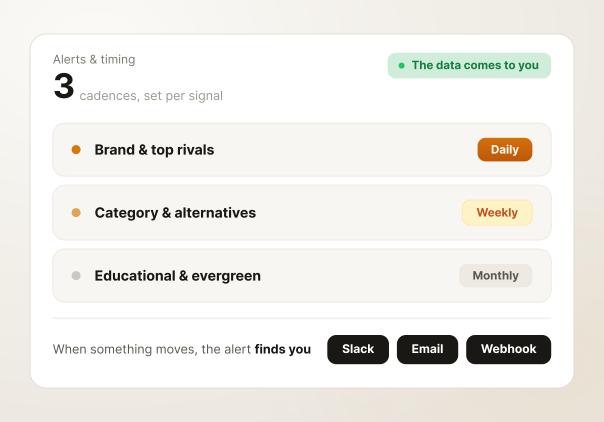
Illustration showing alert notifications arriving in Slack, email, and webhook channels when brand visibility changes

Not every signal deserves the same attention. Your brand and top rivals are checked daily so you catch a shift inside a day. Category and evergreen prompts run weekly or monthly, which keeps the trend lines clean and the noise down.

When something does move, the alert finds you where you already work. A drop, a souring tone, or a new competitor citation lands in Slack, in an email digest, or in your own systems through a webhook.

  • Daily, weekly or monthly, set per signal
  • Slack, email digests, webhooks and mobile push
  • Connects to Slack, Search Console, Zapier and a REST API
How it compares

Most tools sample a corner of the board. GrackerAI watches all of it.

A typical AI monitoring toolGrackerAI
Watches three or four enginesWatches all eight that B2B buyers use
Saves a summary or a single scoreKeeps the full answer, word for word
Reports one blended numberRuns a monitor per persona and per region
Reads one reply and trusts itSamples repeatedly so the number is stable
Cannot tell when AI gets you wrongFlags wrong claims about your brand
Waits for you to open a dashboardSends the alert to Slack, email or webhook
In action

What it catches that nothing else does

Two moments where being first to know is the difference between owning the answer and chasing it.

Cybersecurity, a fresh CVE

When a major CVE drops, every vendor races for attention

The advisory that AI cites in the first 48 hours tends to own the story. Here is how teams use monitoring to get there first.

  1. Watch answers for the new CVE number the moment engines start mentioning it.
  2. Get a Slack alert as soon as AI responses about the CVE appear.
  3. See which competitor advisories the engines are already citing as evidence.
  4. Publish your own coverage within hours, then watch the citations move.
B2B SaaS, switcher intent

For an auth platform watching "Auth0 alternatives" every day

Monitoring across ChatGPT, Perplexity and Claude shows exactly where to act.

  1. See whether you make the alternatives list at all, and how high up.
  2. Find the comparison pages AI cites, then build something better.
  3. Track how the framing changes after a competitor's price hike or outage.
  4. Spot the prompts where rivals show up and you do not, and fix those first.
"AI-optimized content positioned us as experts in our niche. The results have been game changing."
+73% AI visibility
+48% business impact

Edward Zhou, Co-founder and CEO, Gopher Security

What it means for your team

Stop explaining a drop after the fact. Start running the channel as it moves.

Once you can see every answer, for every buyer, in every market, AI visibility stops being a mystery you account for later and becomes a channel you actually manage.

8 engines watched, the full set B2B buyers use
6 signals read from every answer, in full
24h to catch a shift, not a quarter later
40+ countries covered, down to the city
Works with

Monitoring is the sensor. Here is what it feeds.

AI Prompt Generator

Build the library of buyer questions worth watching, grounded in real demand and ranked by what you can win.

See Prompt Generator

Competitor LLM Monitoring

Track every rival mention and see exactly where they are earning citations you are missing.

See Competitor Monitoring

Recommendation Engine

Turn what monitoring finds into a ranked list of fixes, so the gap you spot today becomes the work you ship tomorrow.

See Recommendation Engine

Do not let AI keep
recommending someone else

Get your free AI Visibility Score in about a minute. See exactly where you stand, where competitors are beating you, and the ranked fixes to get into the answer. No credit card, no commitment.

Free in about a minute. Trusted by 500+ B2B and security teams.

Partnered with
  • Microsoft
  • Google
  • Amazon AWS
  • Cloudflare
  • Nvidia
Powered by
  • Google Gemini
  • Open AI
  • Claude