Platform · AI Visibility

Map the sources AI engines actually trust in your category.

When ChatGPT recommends a tool, it pulls from specific web pages. LLM Citations shows you exactly which domains AI engines trust — so you know where to invest.

No credit card required · Ready in 60 seconds

How AI engines actually work

AI engines don't make up answers. They cite sources.

When ChatGPT recommends an SSO platform, it doesn't generate the recommendation from training data alone. It pulls from specific web pages — listicles, blog posts, Reddit threads, G2 reviews, vendor docs — and synthesizes them into a response.

Synthesis, not generation

AI engines retrieve and synthesize content from real pages. The pages they pull from determine who gets recommended — not who has the best product.

Citation authority compounds

A domain cited frequently by AI engines earns compound authority over time. Each citation makes future citations more likely — first-mover advantage is real.

Invisible without a map

If you don't know which pages AI engines trust in your category, you don't know where to invest. LLM Citations gives you that map.

Two views, one source of truth

The macro view and the drill-down

Citations Overview

The macro view

Three top-line metrics tell you the shape of your category:

  • Unique Domains — How many distinct websites AI references. Indicates breadth of citation surface.
  • Citation Occurrences — Total citation count. The ratio to Unique Domains reveals concentration.
  • Top Domain Share — The share held by the most-cited domain.

Plus a ranked list of the top 15 cited domains with mention counts and share of voice.

Citations Detail

The drill-down

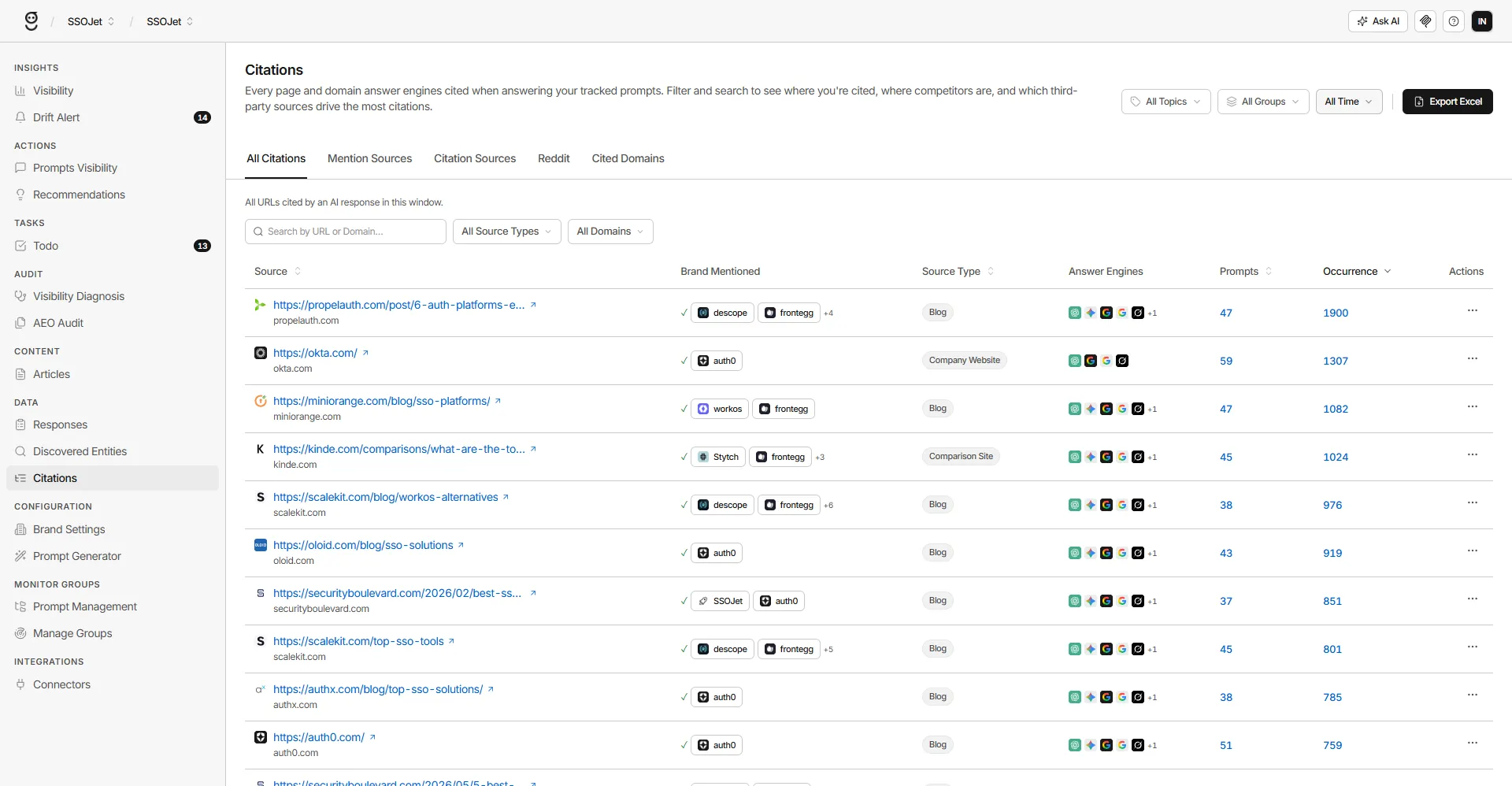
Every URL AI has cited, ranked by occurrence count. Each row shows:

  • Cited URL — With favicon for quick source identification
  • Source type — Website, Corporate, Media, or Forum
  • Engine coverage — Which AI engines cite this URL
  • Occurrence count — How many times it's been cited
Top cited domains — share of voice
6,872 Unique domains
10,698 Total occurrences
5.54% Top domain share
g2.com Website
592
capterra.com Website
481
274
otterly.ai Corporate
241
219

Top 7 of 15 shown · sorted by occurrence count

Pattern recognition

What your top-15 domains list reveals

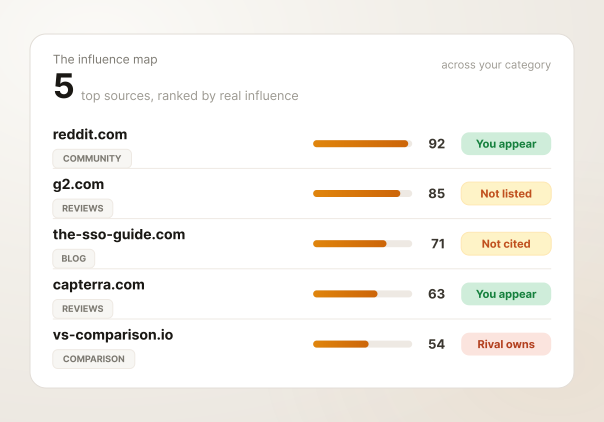
The shape of your top-15 cited domains reveals your category's authority structure — and the right strategy to compete.

PatternSignal typeStrategy
Aggregator dominance G2, Capterra, industry pubs in top 5Listicles drive most citationsEarn placements via direct outreach
Reddit / forum heavy Multiple subreddits in top 20Community authority mattersBuild authentic technical presence
Single competitor dominant One vendor's domain in top 3They've built compound authorityAudit their content, build stronger versions
Media-heavy TechCrunch, Forbes, trades in top 5PR > contentInvest in earned media + analyst relations
YouTube / video youtube.com in top 15Video content is being citedAdd video to your AEO mix
Citation source types

Understand where authority is coming from

GrackerAI classifies every cited URL so you understand the composition of authority in your category — and what strategy that implies.

Dominant: Website

Standard web content drives your category. Comparison pages, listicles, and blog posts are your priority investment — publish and earn placements.

Dominant: Corporate

Competitors are out-publishing you. Audit their highest-cited pages and build stronger, more authoritative versions with updated data and structured schema.

Dominant: Media

Your category is PR-driven. Earned media and analyst relations will move your AI citations more than blog content alone.

Dominant: Forum

Community presence matters here. Authentic engagement on Reddit, Hacker News, and niche forums builds the kind of authority AI engines trust.

Citation mix — B2B SaaS example
Sourcemix
Website 38% Blogs, docs, comparison sites
Corporate 27% Competitor and peer company domains
Media 21% Editorial publications and news outlets
Forum 14% Reddit, Hacker News, Stack Overflow
Cross-engine authority mapping

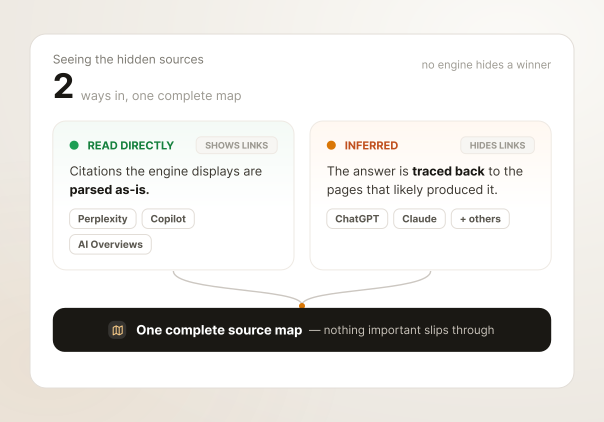
A URL cited by all 6 engines is a fundamental authority

A URL cited by only 1 engine is niche-specific — usually because that engine specifically pulls from a particular data source. Knowing the difference shapes your strategy.

Reddit over-indexes on Perplexity

Perplexity's retrieval layer heavily favors community discussions. Reddit threads often appear exclusively in Perplexity results.

YouTube over-indexes on Gemini

Google's Gemini cites YouTube more than any other engine — especially for product demos, tutorials, and explainer content.

Microsoft Learn over-indexes on Copilot

Microsoft Copilot disproportionately cites learn.microsoft.com. If you're competing in the Microsoft ecosystem, technical documentation matters.

Use Case

Cybersecurity vulnerability source audit

For security vendors, citation patterns around CVEs are uniquely high-leverage. The AI engines that answer vulnerability questions pull from a very specific set of authoritative sources.

How to use Citations for CVE authority

1

Search Citations for nvd.nist.gov, mitre.org, cisa.gov — these are highest-trust sources for AI security responses

2

Check whether your CVE database, vulnerability advisories, or threat intel content appears in the cited list

3

If it doesn't, audit for technical accuracy, update frequency, and structured schema markup — the three factors that drive security citation authority

4

Track week-over-week whether your domain starts appearing in citations after publishing CVE coverage

"
"The AI search optimization strategy gave us visibility we couldn't achieve through traditional SEO. We're now being cited by AI assistants as a trusted source in cybersecurity."
+73% AI Visibility
+48% Business Impact
Use Case

B2B SaaS aggregator placement strategy

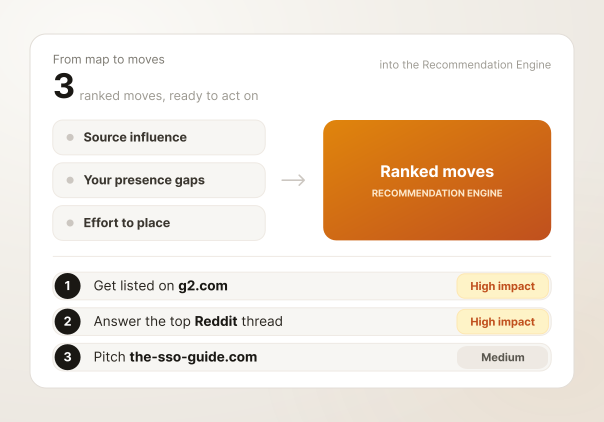
The single highest-ROI move for most B2B SaaS teams is earning placements on the listicles that already rank in their category. GrackerAI Citations shows you which listicles those are.

Four-step aggregator strategy
1

Filter Citations to Type = Website or Media, sorted by Occurrences — the top 10 results are your priority targets

2

Open each listicle URL and check whether your product is included — this takes 20 minutes and gives you your entire outreach priority list

3

Outreach to publishers with a specific differentiator pitch — a concrete data point or customer proof that makes inclusion compelling

4

Track in Citations over the following 4–8 weeks as new placements start generating citation occurrences

Compound citation effect

Each placement compounds — one citation from a high-authority listicle generates hundreds of mentions over the following months.

Month 1
~12 citations
Month 2
~89 citations
Month 3
~241 citations
Month 4
~450 citations

After earning placement on 3 top-10 listicles

Related Products

The complete AEO platform

AI Monitoring

See the responses that produced these citations — track every brand mention, sentiment shift, and source across all AI engines.

Explore AI Monitoring

Competitor Monitoring

Map every competitor mention across AI engines — see exactly where they're gaining citation authority you're missing.

Explore Competitor Monitoring

AI Search Analytics

Prove the ROI of AEO — visibility trends, citation share, and competitor benchmarks in executive-ready reports.

Explore Analytics

AI Search is evolving every day. Don't get left behind.

Discover your AI visibility gaps and start capturing millions of new product discovery clicks.