AI Visibility Intelligence · Brand Perception

It is not just whether AI mentions you. It is what it calls you.

You spent years earning a reputation. AI engines describe you in a sentence, with words you never chose. Brand Perception shows you the exact qualities the models attach to your brand and your rivals — so you can see whether your positioning is landing or whether a competitor owns the words that win deals.

No credit card required. Your perception profile in about a minute.

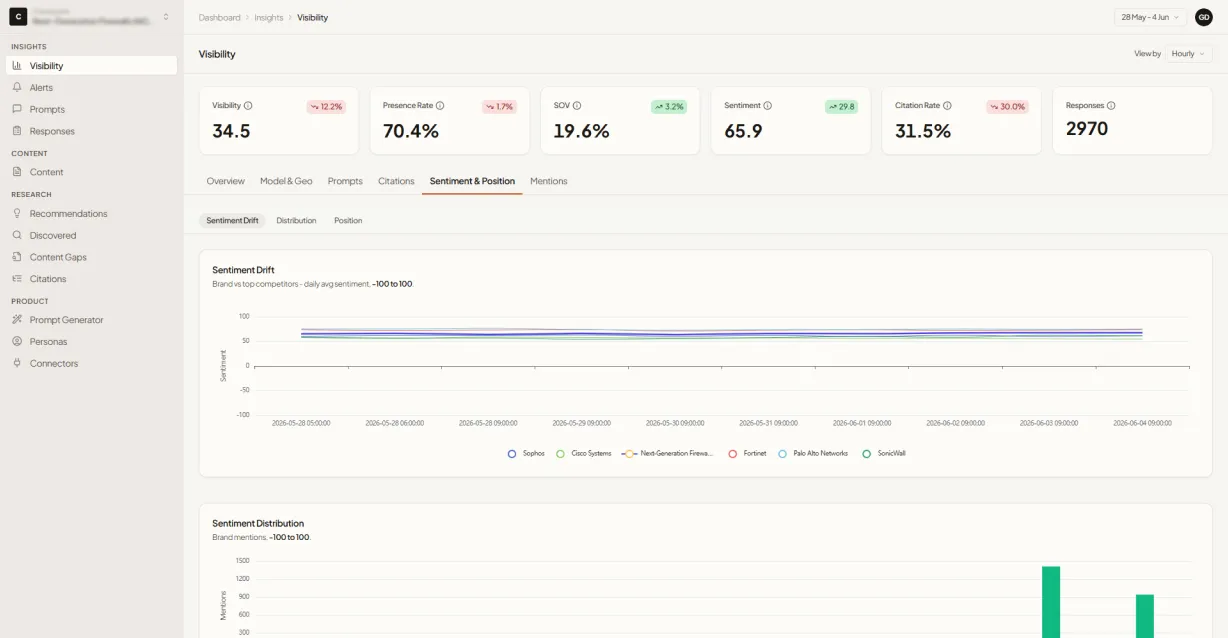
GrackerAI dashboard showing AEO and GEO citation tracking across ChatGPT, Perplexity, Claude, and Gemini
Getting named is not the same as getting positioned.

AI puts you in the answer. Then it decides, in a few words, what you stand for.

You can be mentioned in every relevant answer and still lose, if the words around your name belong to the buyer you do not want or the use case you grew out of. Meanwhile a competitor quietly becomes 'the secure one' or 'the enterprise choice,' and those labels decide the highest-value queries before you are even compared.

The gap

The words do not match

You describe yourself as the enterprise-grade, secure platform. AI may be calling you a simple tool for small teams. You cannot close a gap between intended and actual positioning that you cannot even see.

The loss

A rival owns your word

When the models consistently tie 'most secure' to a competitor, you lose the queries where that quality is the deciding factor — no matter how often you are mentioned elsewhere.

The blind spot

Reputation with no readout

Brand and PR teams track press and social. The AI narrative — which is now the first thing many buyers read — has had no dashboard at all. You are managing a reputation you cannot measure.

See the exact words AI uses for you and your rivals, so you can close the gap between the brand you describe and the brand the models repeat.

How a quality is measured

Turning loose adjectives into a profile you can track

Perception lives in messy sentences, not neat fields. To measure it, every answer goes through the same steps: figure out which quality applies to which brand, translate the wording into a stable attribute, then build it up into a profile you can compare and follow over time.

Read

Take the full answer, the way it was actually written.

Link

Attach each descriptive quality to the right brand.

Normalize

Map the wording to one stable attribute, like 'secure.'

Aggregate

Combine across engines, prompts and repeated runs.

Profile

Your qualities, their strength, and how rivals compare.

Scattered adjectives go in. A clear, comparable perception profile comes out.

The hard part we solved

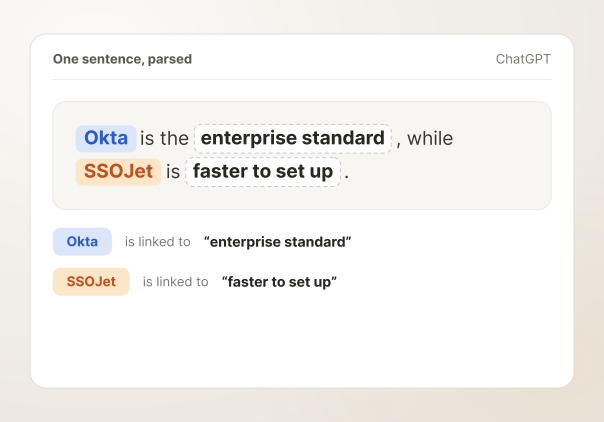
Descriptions come tangled together. A single answer might say "Okta is the enterprise standard, while SSOJet is faster to set up and Auth0 sits in between." That is three brands and three different qualities in one sentence. To track perception honestly, you have to attach each quality to the brand it actually describes, not simply notice that the words appeared near each other.

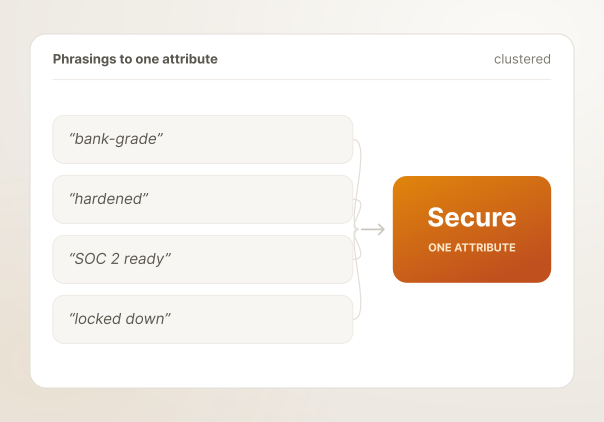
Models also rarely use the same word twice. One reply calls you "rock solid," another says "hardened," a third mentions "SOC 2 ready." Those are the same idea in different clothes. So we cluster the thousands of phrasings into a stable set of attributes, then measure the same attributes the same way across every engine. Without that, you would be counting synonyms instead of tracking a reputation.

Linking quality to brand

The right adjective, credited to the right name

This is where simple keyword tools fall apart. They see "enterprise" and "fast" in an answer that mentions you and assume both are about you. Often they are not. One belongs to a competitor and one belongs to you, and getting that backwards turns your perception data into fiction.

GrackerAI reads each answer for the actual brand-to-quality links, so a description is only ever credited to the brand it truly describes.

  • Each quality tied to the brand it modifies, not the nearest name
  • Handles several brands and qualities in one sentence
  • Keeps your profile honest, even in messy comparisons
Diagram showing how each descriptive quality in an AI answer is linked to the specific brand it describes, not credited to the nearest name
Clustering the language

A dozen ways to say 'secure,' counted as one quality

If you tracked raw phrases, "bank-grade," "hardened," and "SOC 2 ready" would all look like separate, tiny signals. Each on its own seems minor. Together they are a clear statement that AI sees you as secure.

So we group the many phrasings models use into a stable set of attributes. That is what lets you watch a single quality rise or fall over months, instead of drowning in one-off wording.

  • Synonyms and related phrases collapse into one attribute
  • Stable themes you can track and compare over time
  • The same attribute set applied to every brand, fairly
Illustration showing how many different phrases like bank-grade, hardened, and SOC 2 ready are clustered into one stable 'secure' attribute
The perception map

See your reputation and a rival's, side by side

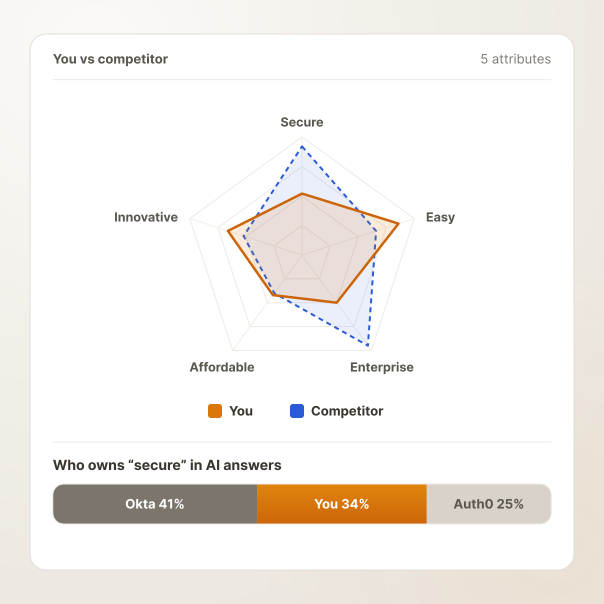
Once every quality is linked and normalized, your brand has a shape. So does each competitor. Laid over each other, the gaps jump out: the qualities you own, the ones a rival owns, and the open ground nobody has claimed yet.

For any single attribute, you can go deeper and see exactly how the association splits between you and your competitors. That is share of voice, but for a quality rather than a mention.

  • Your full attribute profile at a glance
  • Overlaid against any competitor you choose
  • Per-attribute ownership, so you know which words to fight for
Perception map showing your brand's attribute profile overlaid against a competitor's, with gaps and owned qualities highlighted
Watching it move

Catch a narrative shift while it is still a trend

Perception is not fixed. Models update, you publish, competitors push their own story, and the words slowly change. Because we measure the same attributes the same way over time, you see a quality strengthen or slip while you can still do something about it.

Attribute trend — "Secure" Last 6 months · all 8 engines
You41% ↓
Rival A57% ↑

"Secure" is drifting toward Rival A. Catch it here before it hardens into the default answer.

Each attribute tracked as a trend, not a one-time snapshot
See the effect of your content and PR on how AI describes you
Spot a souring or strengthening narrative early
How it compares

Sentiment tells you the mood. Perception tells you the message.

Mention or sentiment trackingBrand Perception
Counts how often you appearShows the qualities tied to your name
Scores tone as positive or negativeNames the specific words, like secure or modern
Credits any nearby adjective to youLinks each quality to the brand it describes
Treats every phrasing separatelyClusters phrasings into stable attributes
Looks at your brand aloneMaps you against rivals, attribute by attribute
A snapshotA trend you can act on early
In action

What seeing the words lets you do

Two jobs that go from guesswork to evidence the moment you can see your perception profile.

Find your positioning gap

Start by comparing the brand you intend with the brand AI actually describes

  1. List the qualities your positioning is built on, like secure and enterprise-ready.
  2. Check your profile to see which of those AI already associates with you.
  3. Spot the gap: the qualities you claim but the models do not yet repeat.
  4. Hand that gap to content and PR as a clear, specific brief.
Win back a quality

When a rival owns a quality that decides deals, perception data shows you how to take it

  1. Pick the attribute a competitor owns, for example 'most secure.'
  2. See which sources and proof points the models cite for that claim.
  3. Publish stronger evidence: certifications, customer proof, technical depth.
  4. Watch the ownership bar shift in your favor over the following months.
"GrackerAI helped us establish market presence and reach the right buyers. A brilliant approach to growth."
+69% AI visibility
+41% business impact

Andy Agarwal, Head of GTM, Kveeky

What it means for your team

Manage your AI reputation on purpose, not by accident.

When you can see the words, branding stops being a hope and becomes a plan. You know which qualities you own, which ones to defend, and which to take from a rival — all in language the models actually use.

8 engines your brand narrative is read across
Per quality share of voice on each attribute, you versus rivals
Trend-early catch a shift before it becomes the default answer
1 profile the exact words AI uses for you, in one view
Works with

Perception is the message. Here is how you shape it.

AI Monitoring

The answers your perception profile is built from come from monitoring across all eight engines.

See AI Monitoring

Competitor Monitoring

Go deeper on the rivals who own the qualities you want, and see exactly where they earn them.

See Competitor Monitoring

Content Engine

Turn a perception gap into the articles and proof that teach the models to describe you the way you want.

See Content Engine

AI Search is evolving every day. Don't get left behind.

Discover your AI visibility gaps and start capturing millions of new product discovery clicks.

Partnered with
  • Microsoft
  • Google
  • Amazon AWS
  • Cloudflare
  • Nvidia
Powered by
  • Google Gemini
  • Open AI
  • Claude