AI Visibility Intelligence · AI Search Analytics

Prove that AI search is driving pipeline, not just impressions.

Getting cited by AI feels good. Finance wants to know what it earned. AI Search Analytics finds the traffic AI engines send you, even the kind that hides its source, then follows it through to leads, opportunities, and revenue.

No credit card required. Connect your analytics in minutes.

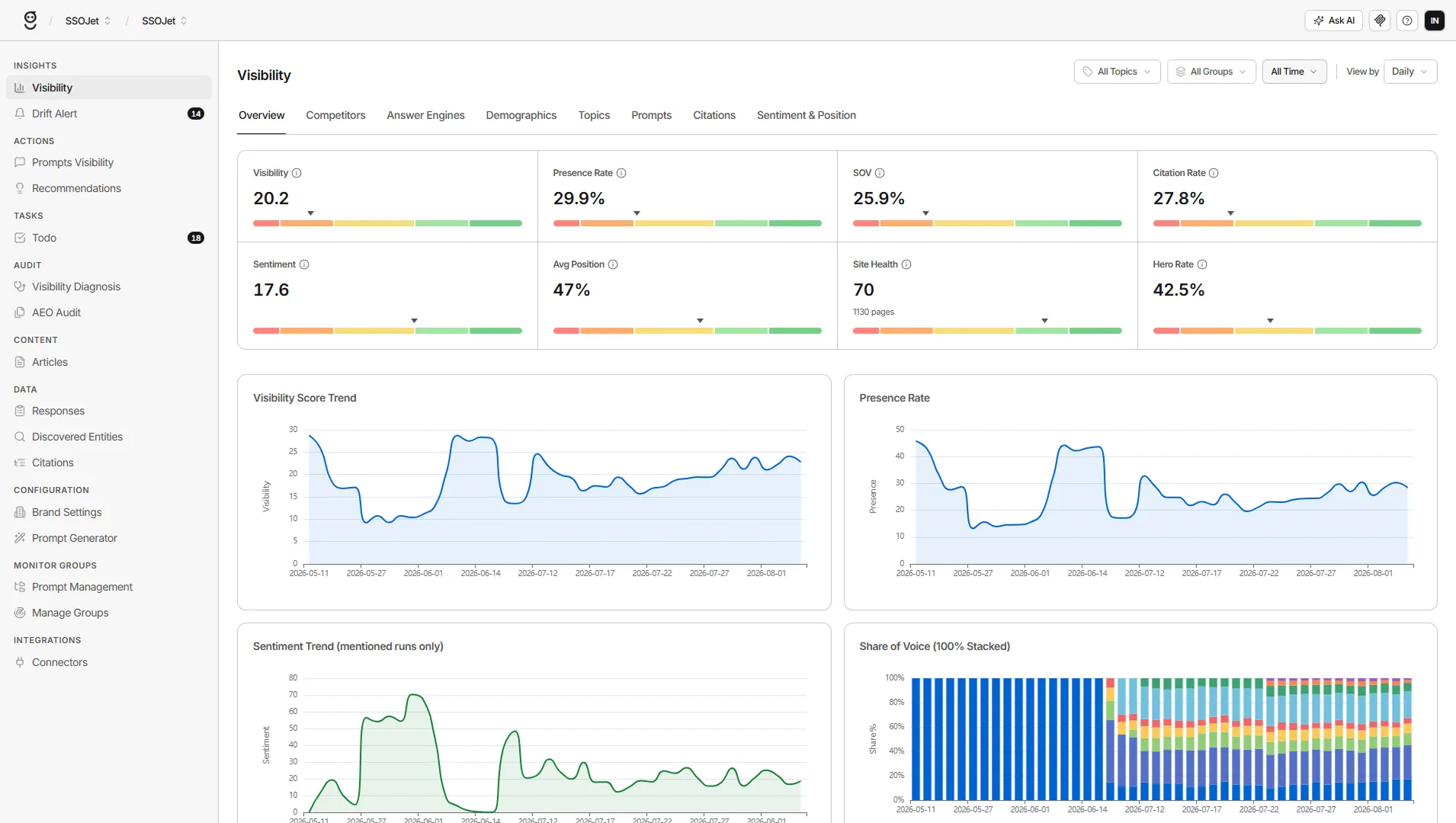
GrackerAI dashboard showing AEO and GEO citation tracking across ChatGPT, Perplexity, Claude, and Gemini
"Great, we are getting cited. So what is it worth?"

The hardest question in AEO is not whether it works. It is proving that it does.

A higher visibility score is a fine story for the marketing team. It is a weak one for finance. The traffic AI sends you is real, but it arrives without a clean label, your normal analytics files most of it under 'direct,' and nobody can draw a straight line from a citation to a closed deal.

Invisible

You cannot see the traffic

Most AI engines do not pass a clean referrer. A click from ChatGPT or Perplexity often lands as 'direct,' lumped in with people who typed your address. The visit is real and the source is gone.

Unattributed

You cannot value it

Even when you spot AI traffic, connecting that visit to a lead, an opportunity, and revenue means stitching three tools together by hand. Most teams never finish the spreadsheet.

Unreportable

You cannot defend the budget

Without a number tying AI search to pipeline, the program is easy to cut and hard to grow. You are funding a channel you cannot put on a slide.

Connect the citation to the click, the click to the lead, and the lead to revenue, so AI search becomes a line on the board deck, not a hunch.

How the loop closes

Following a single citation all the way to revenue

A mention in an AI answer is only the start of a chain. Most tools see the first link and lose the rest. AI Search Analytics tracks the whole journey, from the moment an engine names you to the moment a deal it influenced shows up in your pipeline.

Cited

An AI answer names you for a buyer's question.

Clicked

The buyer follows the citation through to your site.

Identified

We label the visit as AI traffic, even when the source is hidden.

Converted

The session ties to a lead and an opportunity in your CRM.

Reported

It rolls up as AI-sourced pipeline you can show anyone.

Most analytics stops at step 2. The value lives in steps 3 through 5.

The hard part we solved

The catch that defeats standard analytics is the referrer. When someone clicks through from the ChatGPT app or taps a citation in Perplexity, the visit often arrives labeled "direct," the same bucket as a person typing your URL from memory. The traffic is real, the source is stripped away, and marketers call it dark traffic. It is exactly the traffic you most want to count.

Detecting the visit is only half the job. The other half is following it. A click is worth little until you know whether it turned into a lead, an opportunity, and revenue. So we connect the AI visit to the session, and the session to the record in your CRM, which lets a citation on one prompt be traced all the way to the pipeline it helped create.

Finding the hidden traffic

We label AI visits even when the engine erases its own fingerprints

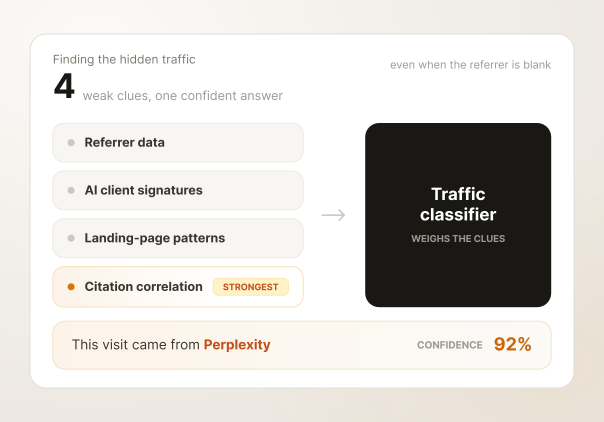
If the referrer were reliable, this would be easy. It is not, so we do not lean on it. GrackerAI combines several weaker clues into one confident answer about where a visit came from, and which engine sent it.

The strongest clue is correlation. If we already recorded that you were cited for a given prompt on Perplexity this morning, and a matching visit arrives soon after, the missing referrer stops being a mystery. Put four signals together and a visit that looked like "direct" becomes "Perplexity, with high confidence."

  • Referrer data, used where engines actually provide it
  • Known signatures of AI clients and apps
  • Landing-page patterns typical of AI answers
  • Correlation with citation events we already logged
Diagram showing how GrackerAI combines referrer data, AI client signatures, landing-page patterns, and citation correlation to identify hidden AI traffic
One timeline, three sources

Visibility, traffic, and pipeline finally sit in the same place

The reason ROI is so hard to prove is that the proof is scattered. Your citations live in one tool, your web sessions in another, your pipeline in a third. AI Search Analytics joins all three on a single timeline, so cause and effect line up by date instead of by guesswork.

The hard part we solved

Three datasets that normally live in three different tools have to be matched on the same identities and the same clock. We align the citation event, the on-site session, and the CRM record so they describe one continuous story rather than three disconnected ones. That join is what turns "we think AI is helping" into a figure you can defend in a budget review.

Advanced analytics

Build the view your team actually needs to see

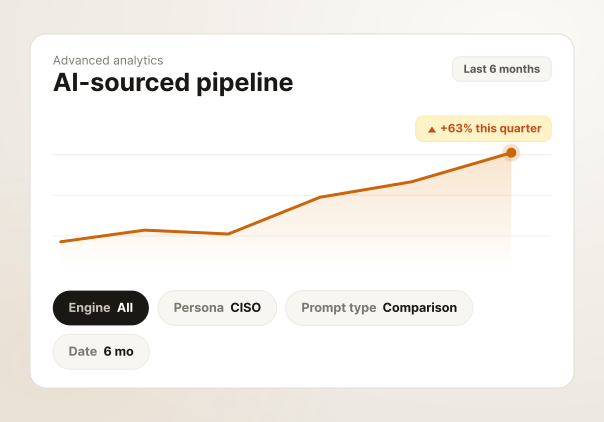
A single fixed dashboard never fits every team. So the numbers are yours to shape. Slice AI-sourced pipeline by engine, by buyer persona, by prompt type, or by date range, and watch the trend lines move as your program does.

Want to know which kind of prompt earns the most revenue, or whether security buyers convert better from Claude than from ChatGPT? Filter to it. The answer is a couple of clicks away, not a data-export project.

  • Custom dashboards arranged around your goals
  • Trend lines that show momentum, not just a snapshot
  • Granular filters by engine, persona, prompt type and date
Advanced analytics dashboard showing AI-sourced pipeline filtered by engine, persona, and prompt type with custom trend lines
How it compares

General web analytics was never built for a channel that hides itself.

General web analyticsAI Search Analytics
Files most AI traffic as "direct"Identifies it and names the engine
No idea a citation drove the visitLinks the visit back to the prompt that earned it
Stops at the sessionFollows the session to pipeline and revenue
Visibility and CRM live apartJoins both on one timeline
Reporting is a manual exportCustom dashboards and filters, ready to share
In action

What proof unlocks

Once AI search has a revenue number next to it, two things get a lot easier.

Prove ROI to finance

When the budget conversation comes around, you bring a number instead of a narrative

  1. Report AI-sourced pipeline as a single, defensible figure with its trend.
  2. Show the conversion rate of AI visitors against your site average.
  3. Connect specific deals back to the prompts and engines that started them.
  4. Make the case to grow the program with evidence, not optimism.
Decide where to invest next

Not all visibility is equal. The data shows which corners of AI search actually pay

  1. Compare pipeline by engine to see where your real buyers convert.
  2. Find which prompt types, like comparisons or alternatives, drive revenue.
  3. Spot the personas and regions where AI traffic is strongest.
  4. Point your content and monitoring at the places that earn the most.
"We were competing on ads with no results. GrackerAI flipped our strategy, and prospects now arrive already knowing why we are the right fit."
+67% AI visibility
+39% business impact

David Brown, Head of Marketing, SSOJet

What it means for your team

Turn a soft story into a hard number, and a hunch into a budget.

AI search visitors tend to arrive further along and ready to act. Once you can measure that and attribute it, the channel stops being a leap of faith and starts being a line item you can grow on purpose.

3–5× higher conversion from AI search visitors
20–35% more inbound leads attributed to AI-referred traffic
8 engines of traffic identified, including the dark kind
1 view visibility, sessions and pipeline on one timeline
Works with

Analytics proves the value. Here is what creates it.

AI Monitoring

The citation events that analytics correlates against come straight from monitoring across all eight engines.

See AI Monitoring

AI Visibility Score

Pair the pipeline number with the score that summarizes your standing, for a complete picture in one review.

See Visibility Score

Recommendation Engine

Once you know which prompts pay, turn that into a ranked plan of what to publish and fix next.

See Recommendation Engine

Do not let AI keep
recommending someone else

Get your free AI Visibility Score in about a minute. See exactly where you stand, where competitors are beating you, and the ranked fixes to get into the answer. No credit card, no commitment.

Free in about a minute. Trusted by 500+ B2B and security teams.

Partnered with
  • Microsoft
  • Google
  • Amazon AWS
  • Cloudflare
  • Nvidia
Powered by
  • Google Gemini
  • Open AI
  • Claude