Maximizing ChatGPT Brand Mentions: The Complete AI Citation Playbook

For years, digital marketing revolved around one question: "How do we rank higher on Google?"
Today, a more important question is emerging:
How do we get recommended by AI?
Millions of users now rely on ChatGPT, Gemini, Claude, Perplexity, and other generative search engines to discover software, compare solutions, research vendors, and make purchasing decisions. Instead of browsing multiple websites, users increasingly trust AI-generated recommendations.
This shift is creating a new visibility challenge for brands. Traditional SEO can help you rank, but ranking alone does not guarantee that AI systems will mention your company.
The brands winning in generative search are not necessarily the ones with the highest traffic. They are the brands that AI systems trust enough to cite.
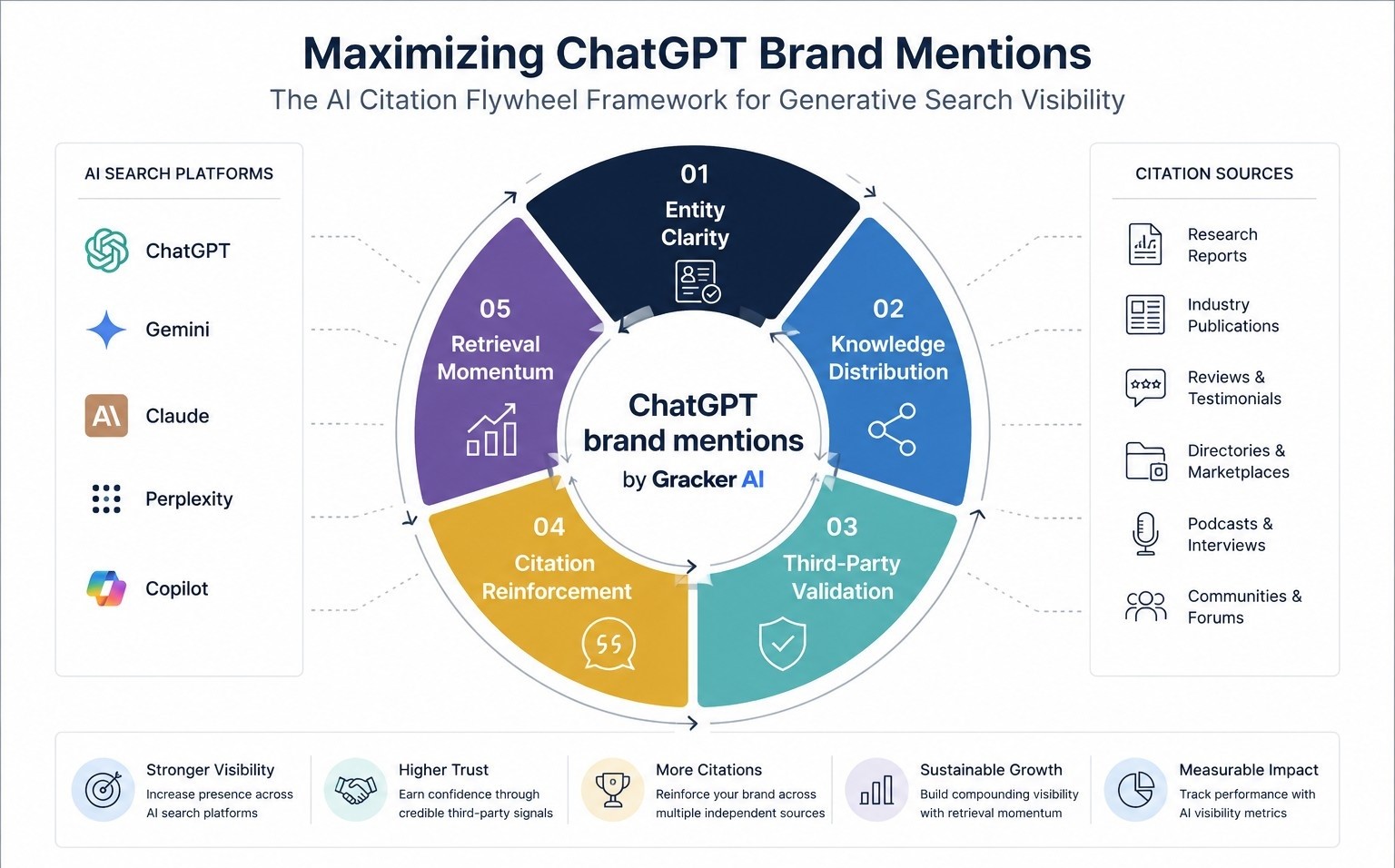
At Gracker AI, we've observed a pattern across AI search ecosystems: the most frequently cited brands have built what we call the AI Citation Flywheel—a system that compounds authority, trust, and discoverability over time.
The Rise of AI Search: What the Data Shows
The shift toward AI-powered discovery is no longer theoretical.
Recent industry research highlights several important trends:
AI Search Trend | Impact on Brands |
|---|---|
Users increasingly ask conversational questions instead of searching keywords | Brands must optimize for topics and expertise, not just keywords |
AI assistants provide direct recommendations | Visibility depends on being cited, not simply ranked |
AI systems synthesize information from multiple sources | Third-party validation becomes more important |
Buyers use AI during research and vendor evaluation | Brand mentions influence purchasing decisions earlier in the funnel |
Unlike traditional search engines that primarily rank pages, generative AI systems evaluate entities, relationships, authority signals, and supporting evidence across the web.
This means brands need a new framework for visibility.
Why ChatGPT Mentions Matter More Than Rankings
When an AI assistant recommends your brand, it compresses the buyer journey.
Users often receive a shortlist of solutions without ever visiting a traditional search results page. If your brand is not included in that shortlist, you're invisible during a critical decision-making moment.
This is why AI citations are becoming one of the most important leading indicators of digital visibility.
A mention from ChatGPT is not just exposure.
It is a signal that your brand has achieved enough authority, relevance, and trust to be surfaced as an answer.
The challenge is that most companies are still optimizing for clicks while AI systems are optimizing for confidence.
Understanding this difference is the foundation of modern Generative Engine Optimization (GEO).
Introducing the AI Citation Flywheel
Most GEO advice focuses on publishing more content.
The problem is that content alone rarely creates sustained AI visibility.
The brands dominating AI recommendations typically follow a repeatable pattern that strengthens over time.
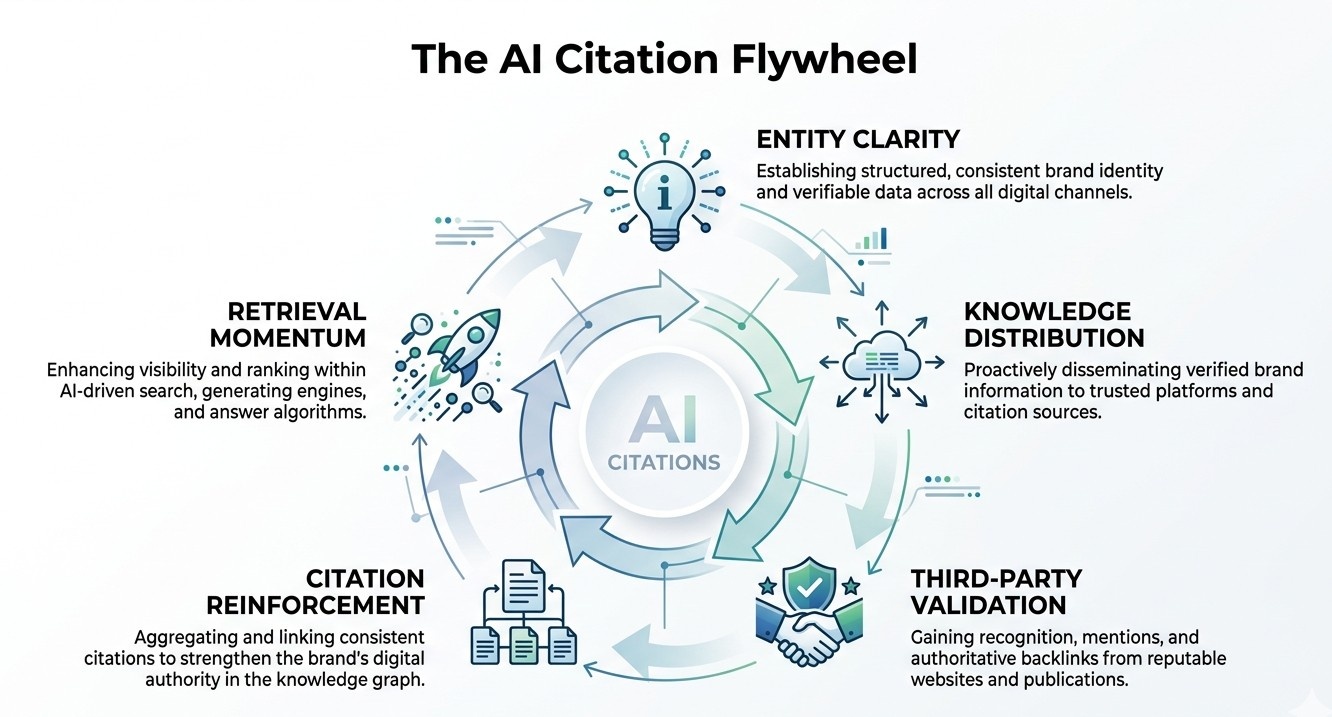
We call this the AI Citation Flywheel.
The flywheel consists of five interconnected stages:
Entity Clarity
Knowledge Distribution
Third-Party Validation
Citation Reinforcement
Retrieval Momentum
Each stage increases the probability that AI systems will reference your brand.
Together, they create a self-reinforcing cycle of visibility.
The AI Citation Flywheel at a Glance
Stage | Primary Goal | Key Outcome |
|---|---|---|
Entity Clarity | Define who you are | Strong brand understanding |
Knowledge Distribution | Expand expertise footprint | Increased discoverability |
Third-Party Validation | Build trust signals | Higher citation confidence |
Citation Reinforcement | Create consistency | Stronger entity associations |
Retrieval Momentum | Compound visibility | More frequent AI mentions |
Stage 1: Build Entity Clarity
Before AI systems can recommend your company, they must understand exactly what your company does.
Many organizations unintentionally confuse AI models by describing themselves differently across various platforms.
Your website says one thing.
Your LinkedIn profile says another.
A software directory lists you differently.
A podcast host introduces you differently again.
These inconsistencies weaken AI confidence.
The solution is simple: establish a clear, repeatable brand description that appears across every major digital footprint.
For example:
"Gracker AI is an AI Visibility and Generative Engine Optimization platform that helps cybersecurity and B2B SaaS companies monitor AI citations, improve AI discoverability, and increase AI Share of Voice."
When AI systems encounter the same positioning repeatedly, entity recognition becomes stronger.
Entity Clarity Checklist
✅ Consistent company description
✅ Structured organization schema
✅ Updated company profiles
✅ Consistent category positioning
✅ Unified messaging across channels
Stage 2: Prioritize Knowledge Distribution Over Content Production
Most companies create content.
Few companies distribute knowledge.
This distinction matters.
AI engines learn from multiple sources across the web. They develop confidence when expertise appears consistently across independent websites and platforms.
Instead of focusing solely on your blog, expand visibility through:
Industry publications
Software directories
Podcast interviews
Research reports
Community discussions
Expert roundups
Knowledge bases
Educational resources
Think of each platform as another node in your brand's knowledge graph.
The objective is not simply earning backlinks.
The objective is ensuring your expertise exists everywhere AI systems look.
Distribution Impact Framework
Channel Type | AI Visibility Value |
|---|---|
Industry Publications | High |
Research Reports | High |
Podcasts | Medium-High |
Community Discussions | Medium |
Directories | Medium |
Social Posts | Low-Medium |
The broader your distribution footprint, the stronger your AI discoverability becomes.
Stage 3: Earn Third-Party Validation
One of the biggest misconceptions in GEO is that your website is the primary source of authority.
In reality, AI systems often place greater trust in independent validation.
A useful framework is:
First-party content creates claims.
Third-party content creates evidence.
Anyone can claim to be an expert.
However, when respected publications, analysts, customers, and industry leaders discuss your expertise, AI systems gain additional confidence in mentioning your brand.
This is why guest contributions, interviews, reviews, research citations, and industry recognition often have an outsized impact on AI visibility.
The goal is not just being present.
The goal is being talked about.
Examples of High-Trust Validation Signals
Analyst mentions
Industry awards
Customer reviews
Research citations
Expert interviews
Conference speaking engagements
Independent product comparisons
These signals help AI systems verify credibility beyond your own website.
Stage 4: Create Citation Reinforcement
Not all mentions are equally valuable.
The strongest AI visibility occurs when multiple independent sources repeat the same positioning.
For example, imagine ten different websites mentioning:
"Gracker AI helps cybersecurity companies improve AI visibility."
This repetition reinforces a consistent association.
Now imagine those same websites describing the company in ten completely different ways.
The signal becomes fragmented.
Citation Reinforcement is the process of ensuring your brand narrative remains consistent across the web.
The more consistent the signal, the easier it becomes for AI systems to retrieve and recommend your brand.
This is where many competitors fail.
They focus on generating mentions rather than engineering consistency.
Citation Reinforcement Formula
More Consistent Mentions = Higher AI Confidence = More Recommendations
This principle is increasingly important as AI systems rely on corroborated information from multiple sources.
Stage 5: Generate Retrieval Momentum
Retrieval Momentum is one of the least understood concepts in AI visibility.
As your brand accumulates citations, mentions, reviews, discussions, and references, AI systems encounter it more frequently during retrieval processes.
This creates a compounding effect.
More mentions lead to more exposure.
More exposure leads to more discussions.
More discussions create more citations.
More citations increase retrieval frequency.
Over time, visibility begins accelerating.
The brands dominating AI recommendations today are often benefiting from years of accumulated Retrieval Momentum.
The good news is that every new citation contributes to future discoverability.
How Retrieval Momentum Compounds
Citation → Mention → Discussion → Reference → Retrieval → Recommendation
Each cycle strengthens future visibility.
The New Metrics Every GEO Team Should Track
Traditional SEO metrics remain useful, but they do not fully explain AI visibility.
Modern GEO teams should monitor:
AI Share of Voice
How often your brand appears compared to competitors.
Prompt Coverage
The percentage of relevant prompts that generate a brand mention.
Citation Penetration
The number of trusted sources mentioning your company.
Entity Consistency
How consistently your brand is described across platforms.
Citation Reinforcement Rate
The frequency of recurring brand-topic associations.
GEO Measurement Dashboard
Metric | Why It Matters |
|---|---|
AI Share of Voice | Measures competitive visibility |
Prompt Coverage | Tracks recommendation frequency |
Citation Penetration | Measures authority footprint |
Entity Consistency | Evaluates brand clarity |
Citation Reinforcement Rate | Measures confidence signals |
These metrics provide a clearer picture of how AI systems perceive your brand.
What's the Best Tool to Check If ChatGPT Mentioned Your Brand?
One of the most common questions marketers ask is:
"How do I know if ChatGPT is mentioning my brand?"
Unlike traditional search engines, ChatGPT does not provide a native dashboard that shows when, where, or why your brand appears in AI-generated responses.
As a result, many teams rely on manual testing—running prompts one by one across ChatGPT, Gemini, Claude, Perplexity, and other AI platforms. While this can provide occasional insights, it quickly becomes difficult to scale and impossible to benchmark consistently.
To effectively monitor AI visibility, brands need visibility into:
How often their brand appears in AI-generated answers
Which prompts trigger mentions
Which competitors are being recommended instead
Changes in AI Share of Voice over time
Citation sources influencing recommendations
Emerging opportunities to improve AI discoverability
This is where specialized AI visibility platforms become valuable.
GrackerAI helps marketing teams track brand mentions across major AI search engines, monitor AI Share of Voice, identify citation opportunities, benchmark competitors, and understand how generative AI systems perceive their brand.
What to Look for in an AI Mention Monitoring Tool
Not all AI visibility tools provide the same level of insight.
The most useful platforms should help answer five questions:
Question | Why It Matters |
|---|---|
Is my brand being mentioned? | Measures baseline AI visibility |
Which prompts trigger mentions? | Identifies discoverability opportunities |
Who is outperforming me? | Reveals competitive gaps |
Why are competitors being cited? | Uncovers authority signals |
How is visibility changing over time? | Measures GEO performance |
The goal is not simply tracking mentions.
The goal is understanding the confidence signals that influence AI recommendations and using those insights to increase future visibility.
As AI-powered discovery becomes a larger part of the buyer journey, monitoring brand mentions in generative search is quickly becoming as important as tracking keyword rankings in traditional search.
The Future of Visibility Is Recommendation
The next generation of digital discovery will be driven by recommendation engines rather than search engines.
AI systems are increasingly deciding which brands users see, trust, and evaluate.
Winning this new landscape requires more than content production.
It requires building confidence.
Brands that establish entity clarity, distribute knowledge effectively, earn third-party validation, reinforce citations, and generate Retrieval Momentum will become the default recommendations in AI-generated answers.
The question is no longer whether AI citations matter.
The question is whether your brand is building an AI Citation Flywheel strong enough to make itself impossible for AI systems to ignore.
Because in the age of generative search, recommendation is the new ranking.