
10 Best Tools to Check if ChatGPT Mentions Your Brand 2026

Ankit Agarwal · Head of Marketing
· Updated November 6, 2026
GrackerAI, Otterly AI, Geoptie, Searchable, and Peec AI are the strongest tools for checking whether ChatGPT mentions your brand, ranked below by tracking depth, platform coverage, and (for GrackerAI and Searchable specifically) whether the tool also helps close a citation gap once it finds one. More than half of B2B software buyers (51%) now start purchase research in an AI chatbot rather than a search engine, up from 29% a year earlier (G2, The Answer Economy: How AI Search Is Rewiring B2B Software Buying, March 2026 survey of 1,076 B2B buyers, retrieved 2026-09-16). ChatGPT alone handles over 2.5 billion prompts a day (OpenAI CEO Sam Altman, reported by TechCrunch, retrieved 2026-09-16).
When a CISO asks “best SIEM for mid-market” or “top zero trust vendors,” the model doesn’t return ten blue links. It returns a shortlist, with sources behind it. Being mentioned isn’t the same as being trusted, and being trusted isn’t the same as being cited correctly. It’s also not the same as generating pipeline. See why brand mentions in ChatGPT and Perplexity matter for demand generation for how that shortlist moment connects to actual deals, not just awareness.
This guide ranks the tools built to track that gap by depth and accuracy for security vendors specifically, and shows what each one actually reports once you look past the marketing page.
Short answer: if you only want to confirm whether your brand shows up for a handful of prompts, a free manual check in ChatGPT is enough (how to run one). If you need to track dozens of buyer prompts over time, compare share of voice against competitors, and see which sources a competitor is winning on, you need one of the tools below. The 6-step tracking process further down works with any of them.
Quick Comparison
Tool | Starting Price | Standout Feature | Platforms Tracked | Content Generation |
|---|---|---|---|---|
$99/mo | Diagnoses why a prompt is lost, then writes the fix | 3/4/10 Engines as per plan | ✓ (plus rewrites of existing pages) | |
Otterly AI | $29/mo | Lowest entry price, GEO URL audits | 4 platforms | ✗ |
Geoptie | $41/mo | Any 4 of 7 engines at every tier, flat pricing | 7 platforms (4 per brand) | ✗ |
Searchable | $50/mo | Site audits bundled with mention tracking | 1 (Starter) | ✓ |
Peec AI | $95/mo | Pick your own 3 models from a list of 7 | 3 (custom) | ✗ |
Profound | $99/mo | Prompt volume data, SOC2 compliance | 1 (Starter) | ✓ (limited) |
Gauge | $99/mo | ChatGPT ad and sponsored-content tracking | ChatGPT-focused | ✗ |
Writesonic | $99/mo | Bundles ChatGPT tracking with AI content generation | 1 (Starter), 8+ (Growth) | ✓ |
AthenaHQ | $295/mo | Shopify revenue attribution, citation-probability scoring | Multi-platform | ✗ (content agents only) |
Scrunch AI | $25/mo | Misinformation and brand-safety detection | 8 platforms | ✗ |
1. GrackerAI
Price: $99/month (Individual, or $79/month billed annually), $499/month (Team, or $399/month billed annually), custom (Enterprise)
Best for: Cybersecurity and B2B SaaS vendors who need to know not just whether they’re cited, but why they aren’t and what to publish next
Most tools in this list stop at reporting: here’s your mention count, here’s your sentiment, here’s a chart. GrackerAI was built specifically for security vendors, and it adds two layers most competitors skip entirely.
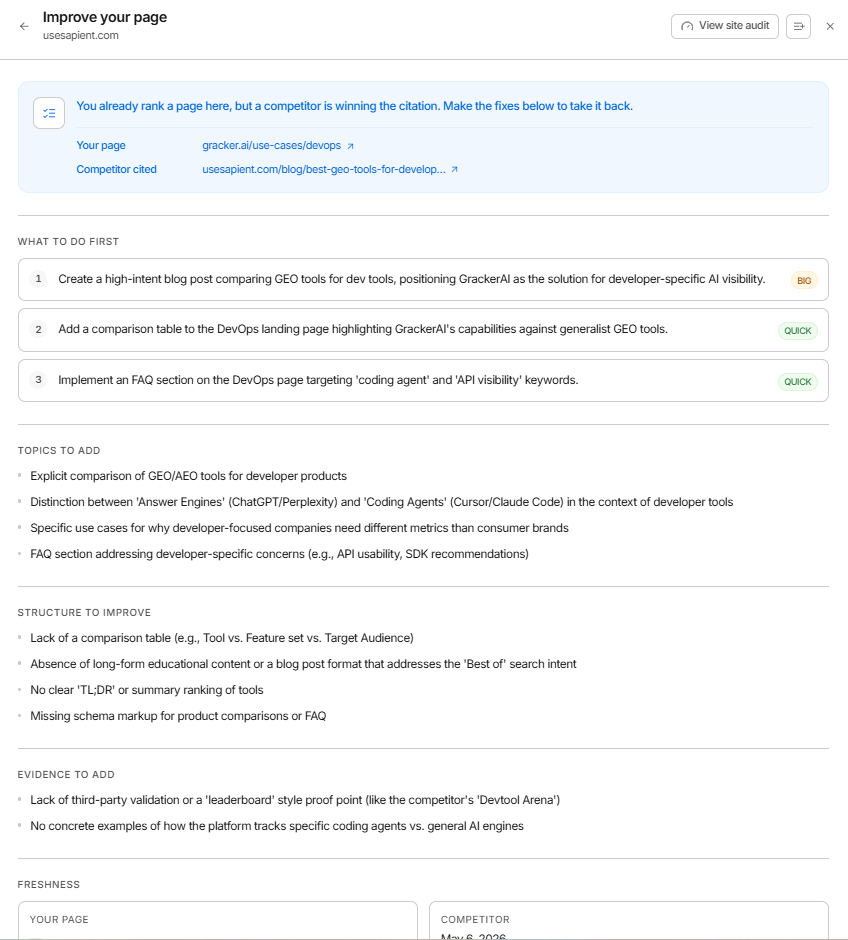
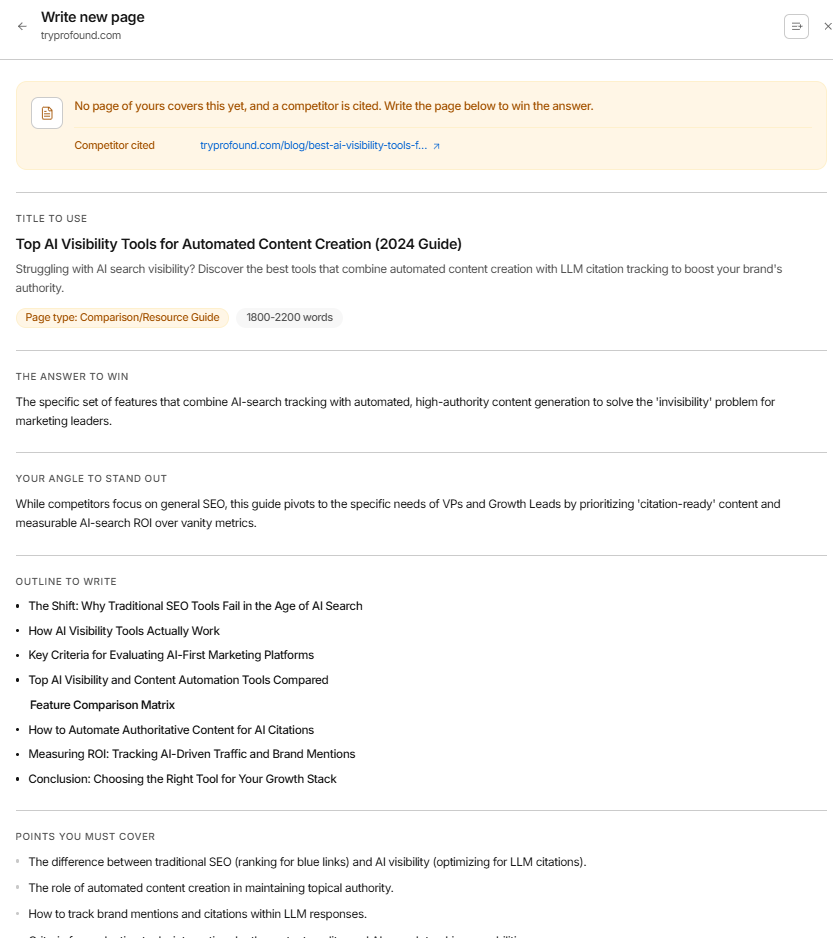
Visibility Diagnosis. Point it at any prompt where the brand isn’t showing up. It searches the vendor’s own site for a page that should be targeting that prompt, scores how well that page actually matches, and pulls the exact competitor pages AI engines cited for that prompt over the last 30 days.
Then it branches: if no page exists, it writes a content brief with the angle, outline, and the specific claims that earn citations. If a page exists but a competitor wins the citation anyway, it returns a gap report showing what’s missing and how stale the page is next to the one that’s winning.
Citation intelligence, not just mention counts. Inside the dashboard’s Citation tool, you can see the specific sources an LLM pulled from to cite a competitor instead of you, on a prompt-by-prompt basis. Top Citing Domains shows which sources AI engines lean on most across your whole category. New and Lost Citation Sources flag when a source starts or stops being cited, which is often the earliest warning that your visibility is about to shift. There’s even a dedicated Reddit view that rolls citations up by subreddit, since security buyers lean on community threads more than almost any other AI answer engines cite from.
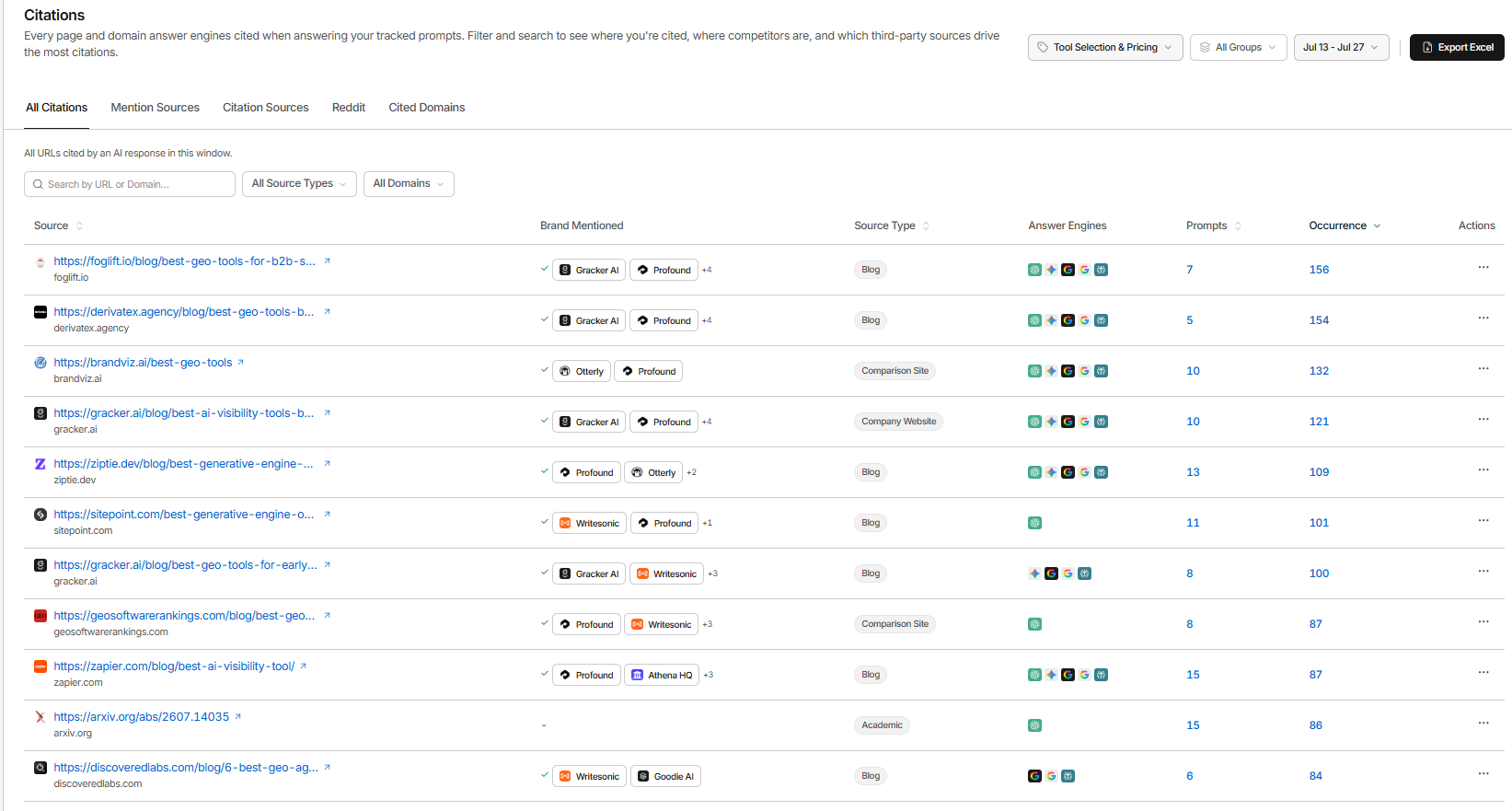
Position Distribution is another one worth knowing about: it’s not enough to appear in an answer if you’re buried at the end. Gracker buckets where your brand lands in a response, from Hero (first third) to Tail (last third), because earlier placement is worth more even at identical mention frequency, a distinction almost none of the tools below report on.
ChatGPT tracking includes
-
Per-engine citation frequency, sentiment, and average citation position (not one blended score)
-
Competitive citation gap analysis, including a Discovered view that catches new competitors entering AI answers before they become a real problem
-
Prompts grounded in real buyer behavior via Google Search Console and Bing Webmaster integration, plus a mining layer that pulls actual questions from People Also Ask and forum discussions
-
AEO Audit scoring every page for citability (structure, evidence, freshness, schema, AI-crawler access) alongside conventional technical health
Limitations: Multi-region tracking requires Enterprise. Seats limited to 1 (Individual) or 4 (Team).
2. Otterly AI
Price: $29/month (Lite), $189/month (Standard), $489/month (Premium)
Best for: Budget-conscious startups getting started with AI visibility
Otterly offers the lowest entry price in the market. The Lite plan tracks ChatGPT, Google AI Overviews, Perplexity, and Microsoft Copilot, with GEO audit tools that analyze how well your pages are optimized for AI citation. Claude and Google Gemini are available as paid add-ons on any tier.
ChatGPT tracking includes:
-
GEO URL audits (1,000-10,000/month)
-
Multi-country support (50+ countries)
-
Unlimited team members
Limitations: Only 15 prompts at Lite tier. No content generation. Google AI Mode requires a paid add-on.
3. Geoptie
Price: $41/month (Starter), $83/month (Professional), $166/month (Enterprise)
Best for: Agencies managing multiple brands
Geoptie gives every tier access to the same 7 AI engines (ChatGPT, Claude, Perplexity, Gemini, Copilot, Google AI Mode, and Google AI Overviews), letting you pick 4 per brand rather than locking engine choice to price tier. Their top tier supports unlimited brands and 400 monitoring prompts.
ChatGPT tracking includes:
-
Unlimited GEO audit reports
-
Multi-brand tracking (2-50 brands depending on plan)
-
6 free GEO tools for evaluation
Limitations: Only 15 prompts at Starter. No content generation features.
4. Searchable
Price: $50/month (Starter), $125/month (Professional), $400/month (Scale)
Best for: E-commerce brands needing site audits alongside ChatGPT tracking
Searchable combines ChatGPT monitoring with technical site audits. The platform checks whether AI crawlers can access your content and identifies technical issues preventing citations.
ChatGPT tracking includes:
-
Brand visibility monitoring
-
Site audits (50-1,000/month)
-
AI shopping data (Scale tier)
-
30% annual discount available
Limitations: Starter tracks ChatGPT only. Additional AI platforms require higher tiers.
5. Peec AI
Price: $95/month (Starter), $245/month (Pro), $495/month (Advanced)
Best for: Marketers who want to choose which AI models to track
Peec AI lets you pick 3 AI models from a list of 7, rather than getting a fixed set. If ChatGPT is your only priority, you can focus your tracking there without paying for platforms you don’t care about.
ChatGPT tracking includes:
-
Flexible model selection
-
Unlimited team seats
-
Looker Studio integration (Advanced)
-
Agency pricing available
Limitations: No content generation. Additional AI models cost $35-$165/month each.
6. Profound AI
Price: Free Trial (ChatGPT only), Custom (Enterprise)
Best for: Enterprise teams needing SOC2 compliance
Profound offers prompt volume data showing how often specific queries are asked on ChatGPT similar to keyword volume in traditional SEO. Their enterprise security (SOC2, SSO) is legitimate if compliance matters.
ChatGPT tracking includes:
-
Brand visibility scores
-
Agent-based content workflows
-
GA4 integration
Limitations: Starter tracks ChatGPT only. Content generation capped at 3 articles/month on Growth. Price jumps significantly between tiers.
7. Gauge
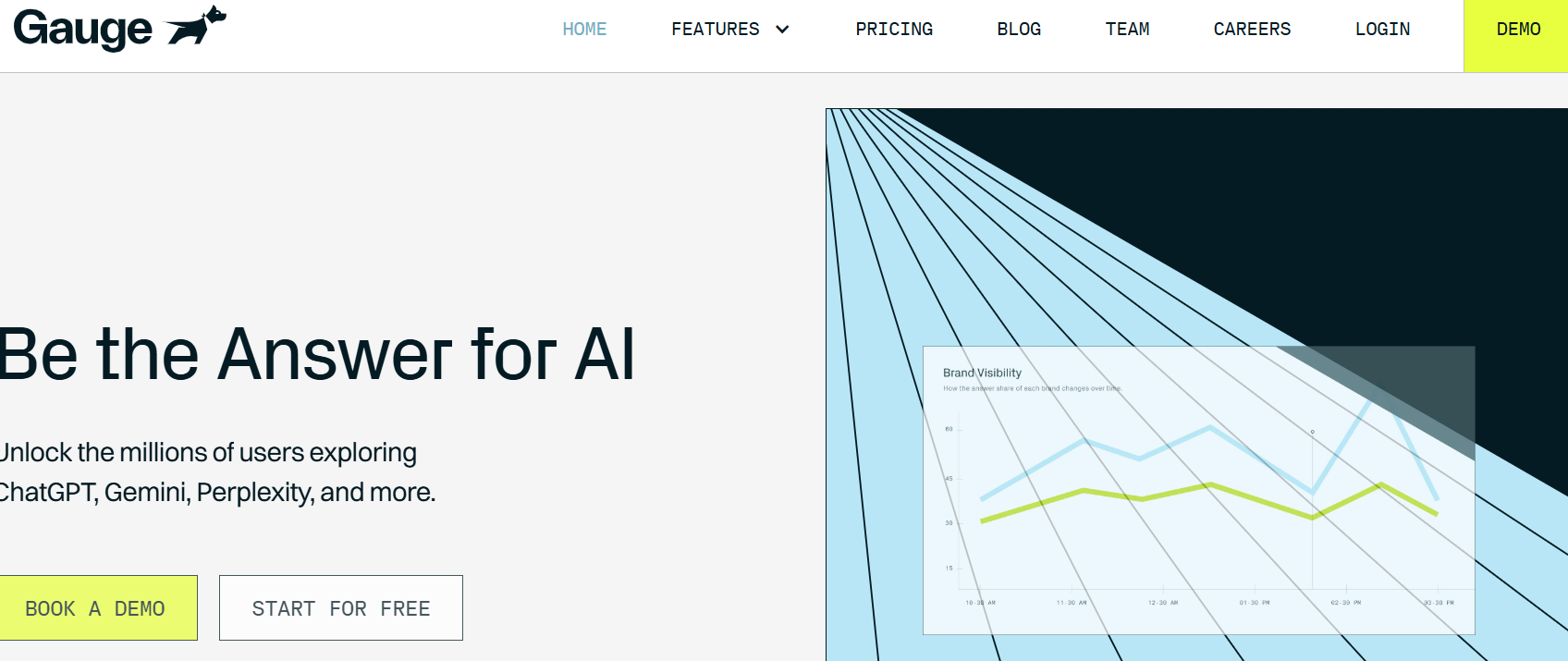
Price: $99/month (Starter), $599/month (Growth)
Best for: Brands monitoring ChatGPT ads and sponsored content
Gauge tracks ChatGPT advertising placements a feature most tools don’t offer. As ChatGPT rolls out more sponsored content, this visibility becomes valuable for e-commerce and DTC brands.
ChatGPT tracking includes:
-
Organic mention monitoring
-
Sponsored content tracking
-
Ask Gauge AI research agent
-
High prompt volume (600 at Growth)
Limitations: Starter tracks ChatGPT only. Steep price jump to Growth tier ($99 to $599).
8. Writesonic
Price: $99/month (Starter), $249/month (Basic), $499/month (Growth)
Best for: Teams wanting AI writing plus ChatGPT tracking in one platform
Writesonic bundles ChatGPT visibility tracking with AI content generation, site audits, and the Chatsonic AI assistant. If you’re already paying for multiple tools, the consolidation makes sense.
ChatGPT tracking includes:
-
Brand mention monitoring
-
Site audits (10-50/month)
-
AI content generation
-
SOC2 + HIPAA compliance
Limitations: Starter tracks ChatGPT only. 8+ AI platforms require Growth tier at $499/month.
9. AthenaHQ
Price: $295/month (Starter), $499/month (higher tiers)
Best for: E-commerce brands using Shopify who need revenue attribution
Founded by ex-Google Search engineers, AthenaHQ connects ChatGPT citations to actual revenue through Shopify integration. Their ACE engine predicts citation probability rather than just tracking current state.
ChatGPT tracking includes:
-
Revenue attribution (Shopify)
-
Citation probability predictions
-
Action Center with content agents
-
Multi-region tracking
Limitations: Premium pricing. Credit-based model can be unpredictable. Best features locked to Enterprise.
10. Scrunch AI
Price: $250/month billed annually ($300/month month-to-month)
Best for: Enterprise brands concerned about AI misinformation
Scrunch focuses on brand safety detecting when ChatGPT says incorrect things about your brand. Their Agent Experience Platform (AXP) creates machine-readable versions of your brand specifically for AI crawlers.
ChatGPT tracking includes:
-
Misinformation detection
-
Brand safety monitoring
-
8 AI platform coverage
-
GA4 integration for bot traffic
Limitations: Highest entry price on this list. No free trial. Credit system can consume prompts faster than expected.
Why “Mention Frequency” Is the Wrong Metric to Optimize Alone
Most of the tools above will happily tell you a number: X% of ChatGPT answers mentioned your brand last month. That number is close to useless on its own, for three reasons
**Frequency without position hides the real story-**Two brands can both get mentioned in 40% of relevant answers, and one is buried in the last sentence while the other opens the response. Position affects how much weight a mention actually carries with the person reading it, which is why tracking Hero-to-Tail placement (not just presence) belongs in any serious evaluation.
Sentiment isn’t binary- A brand can be mentioned accurately but framed as “budget” or “legacy” when it wants to be framed as “enterprise-ready.” Tracking whether AI-generated descriptions of your brand are drifting, and toward what, matters as much as whether you show up at all. This is where narrative tracking earns its place next to sentiment, not as a nice-to-have layer on top of it.
A mention with no traceable source is a dead end- If you don’t know which domain, article, or Reddit thread the model pulled from to make a claim about you or a competitor, you can’t act on it. Citation intelligence, being able to trace an answer back to its actual source, is what turns “we’re invisible on this prompt” into “here’s the exact page winning this citation and here’s what it has that ours doesn’t.”
For the full breakdown of these accuracy metrics (appearance rate, citation type, and Answer Share), see our guide to AI search visibility tools for citation tracking.
How to Choose the Right Tool
If you’re a solo marketer or small team on a budget: Otterly AI or Geoptie give you real tracking at the lowest entry price. Neither generates content, so budget separately for whoever writes the fixes once gaps show up
If you’re an agency managing multiple client brands: Geoptie’s flat pricing across tiers and multi-brand support are built for this. If your clients are in cybersecurity specifically, GrackerAI’s multi-brand tracking keeps each client’s dashboard, competitors, and prompts fully separate rather than blended into one number, with a workspace-level rollup for the agency owner.
If compliance is a procurement requirement: Profound (SOC2) is the straightforward choice at this price point.
If you want tracking and content production in one place, not two vendors: GrackerAI and Searchable are the two on this list that go past monitoring into generating (or rewriting) the actual content needed to close a citation gap. Searchable pairs it with site audits; Gracker pairs it with prompt-level diagnosis of why a specific page is losing.
If you’re specifically in cybersecurity, IAM, or adjacent security SaaS: This is the one place generic tools show their limits. A GEO platform that treats “best CRM” and “best SIEM” prompts the same way will miss the technical accuracy, compliance context, and buyer language security researchers actually search for. GrackerAI’s models are built only for this category, which is a real tradeoff: better fit if you’re in it, wrong tool if you’re not.
What ChatGPT Tracking Actually Shows You
Most ChatGPT monitoring tools provide:
-
Brand mentions - Whether ChatGPT recommends your brand when users ask relevant questions
-
Competitor analysis - How often competitors get cited instead of you
-
Sentiment tracking - Whether mentions are positive, negative, or neutral
-
Query-level data - Which specific prompts trigger (or don’t trigger) your brand
-
Trend analysis - How your visibility changes over time
The tools that go beyond monitoring also help you improve visibility through content recommendations or generation.
How to Check ChatGPT Brand Mentions Manually (for Free)
Before paying for anything, spend 20 minutes running your own prompts. Use a temporary chat so your history and memory settings don’t shape the answers. Three tests surface most problems:
-
“Best tool for X” prompts. Ask the question the way a buyer would, with their context: “best SIEM for a 500-person fintech company,” not just “best SIEM.” Note whether you appear, where in the answer you appear, and who appears above you.
-
Head-to-head comparisons. Ask ChatGPT to compare you with your closest competitor, then read what it lists as your weakness. That framing usually traces back to an old review, a Reddit thread, or an outdated pricing page, which tells you which source needs correcting.
-
“No clear leader” answers. If ChatGPT says there is no clear leader for a use case, nobody has published the definitive answer yet. That prompt is an open slot for a page from you.
Manual checks stop working once you go past a few prompts. Answers vary from one run to the next, so a single check is a sample of one; you can’t see trends; and you can’t see which sources shaped the answer at any scale.
The two tool categories teams usually already own don’t close that gap either. SEO platforms report where your pages rank in Google, which says little about whether ChatGPT recommends you. Traditional brand monitoring tools track where your name appears across the web and social media, not whether an AI answer engine cites or recommends you. That gap is what the tools in this list are built for.
A 6-Step Process for Tracking ChatGPT Brand Mentions
Whichever tool you pick, the setup below is what turns a mention count into a list of things to fix.
Step 1: Build a prompt library. Write 50 to 100 prompts your buyers actually ask, spread across four types: category prompts (“best zero trust vendors for mid-market”), comparison prompts (“Vendor A vs Vendor B”), vendor evaluation prompts (“is Vendor A good for regulated industries”), and problem prompts (“how do I stop credential stuffing”). Pull the wording from sales calls, Search Console queries, and People Also Ask boxes rather than inventing it.
Step 2: Set a share of voice baseline. AI share of voice is the share of tracked prompts where your brand appears. If you’re mentioned in 7 of 10 prompts about “fintech compliance,” your share of voice for that cluster is 70%. Measure competitors on the same prompts, and record position (opening of the answer vs. the last line), not just presence.
Step 3: Trace the citation sources. For every prompt a competitor wins, list the domains ChatGPT drew on: industry publications, directories, review sites, Reddit threads, analyst reports, expert roundups.
Step 4: Find your citation gaps. A citation gap is the difference between where competitors are referenced and where you are. Sources that cite two competitors and never mention you are the gap. In our experience this is usually a distribution problem, not a content problem: the competitor simply exists in more of the places AI engines pull from.
Step 5: Close the gaps on and off your site. On your own pages, put the direct answer in the first 50 or so words under a clear heading, add FAQ schema so the answer is easy to lift, and refresh stale pages, since ChatGPT search and Perplexity pull from the live web and an outdated pricing page or API doc loses to a current one. Off your site, get listed on the directories and review sites your competitors are cited from, contribute to the publications in your category, and describe your brand the same way everywhere so engines recognize it as one entity.
Step 6: Measure what changed. Rerun the library weekly and log which actions moved which prompts. AI engines often pass little clean referral data, so also watch direct traffic and branded searches in Search Console: a buyer who sees your name in ChatGPT often types your URL straight into the browser. For which of these signals matter most to a growth team, see AI visibility metrics: a practical overview for growth teams.
Why ChatGPT Mentions Matter
AI chatbots are now the top-ranked source B2B software buyers say influences which vendors make their shortlist, ahead of vendor websites and paid search, and 85% of buyers think more highly of a vendor an AI chatbot recommends (G2, The Answer Economy, retrieved 2026-09-16). When a prospect asks ChatGPT for a recommendation in your category, being cited is what puts you on that shortlist.
The mechanism differs from search. A ChatGPT answer doesn’t surface ten competing links for a user to scan. It synthesizes one response, and the user typically acts on that response rather than clicking through to verify it first. (ANALYSIS: this makes the citation itself the moment of influence, not a link a buyer might click later.) If your brand isn’t in the answer, there generally isn’t a second chance to appear within that same research session.
Why ChatGPT Recommends Some Brands and Not Others
Google ranks pages. ChatGPT recommends entities. That is why a brand can hold page-one Google rankings and still be missing from ChatGPT’s answer to the same question.
The shift happened fast. ChatGPT launched on November 30, 2022 (OpenAI, “Introducing ChatGPT”, retrieved 2026-09-16). Early GPT models answered from training data alone, and nobody used them to compare vendors, so brand visibility inside them was mostly accidental and no tracking tools existed. Within a year or two, users had moved from “explain SEO” to “what are the best SEO tools,” and certain brands kept appearing in those shortlists while others never did. Today, with web search built in, ChatGPT works as a research assistant and buying advisor, and its answers draw on live sources as well as training data.
From tracking recommendation prompts for clients, we see three patterns repeat. Treat them as GrackerAI’s working model, not the result of a controlled study:
-
Citation diversity beats content volume. Brands with smaller content libraries often appear more often than prolific publishers, because their expertise shows up across publications, directories, review platforms, research reports, and community discussions. AI engines seem to build confidence from many independent sources, not one website.
-
Recommendations compound. We call this Retrieval Momentum: brands that get cited accumulate more supporting signals, which earns them more retrieval, which earns more recommendations. It is one reason established category leaders are hard to dislodge, and why starting early matters.
-
Citations connect content to recommendations. Our AI Recommendation Stack runs brand, then content, then citations, then entity recognition, then AI confidence, then recommendations. Most teams invest heavily in the content layer and almost nothing in the citation layer, which is the one that tracking tools with source-level data make visible.
This is also why mention tracking on its own isn’t enough. A mention count tells you what happened; the sources behind it tell you what to do next.
How This Guide Was Sourced
This guide is written and maintained by GrackerAI’s research and content team, which builds AI search visibility tracking and AI-optimized content production for cybersecurity and B2B SaaS vendors, disclosed here because GrackerAI is also entry #1 on this list below. Pricing, tier names, and tracked-engine counts for GrackerAI, Otterly AI, Geoptie, and Scrunch AI were checked directly against each vendor’s own pricing page as of 2026-09-16 and corrected where they had changed since this guide was last updated; figures for the remaining tools reflect the vendors’ publicly stated pricing at last check and should be reconfirmed on the vendor’s site before you budget against them, since GEO/AEO tool pricing changes often. Industry and usage figures are drawn from G2’s 2026 Answer Economy buyer behavior research and OpenAI’s own reported daily prompt volume, both linked inline above. AI answer engines change their citation and ranking behavior frequently, so pin your reading to the retrieval dates above. The ChatGPT launch date is sourced to OpenAI directly. The Citation Gap, Retrieval Momentum, and AI Recommendation Stack concepts are GrackerAI’s own analysis from advising brands on AI search visibility; they describe patterns observed across client work, not findings from a study with a published sample or methodology. No GrackerAI telemetry is used in this guide; every figure above is external and linked.
Tracking more than ChatGPT? See the best LLM visibility tools for multi-engine reporting.
Frequently Asked Questions
How do I check if ChatGPT mentions my brand for free?
You can manually ask ChatGPT questions your customers would ask and see if your brand appears. For systematic tracking across multiple queries and over time, you’ll need a dedicated tool. GrackerAI, for example, offers a 7-day free trial on its Individual and Team plans (a valid credit card is required to start it, and you can cancel before it ends).
For a structured, repeatable version of that manual process, see Using ChatGPT for AI Search Visibility: Practical Workflows.
How often should I check my ChatGPT visibility?
Weekly monitoring catches trends before they become problems. Most tools provide automated reports so you don’t have to check manually.
Can I improve my ChatGPT mentions?
Yes. Create content that ChatGPT can cite as authoritative comparison pages, in-depth guides, FAQ content, and original research. Tools with content generation features help create this systematically.
Does ChatGPT tracking also cover GPT-4 and GPT-4o?
Yes. Most tools track ChatGPT responses regardless of the underlying model version. Some enterprise tools like Profound specifically call out GPT-5.2 tracking.
What’s the difference between ChatGPT tracking and GEO?
ChatGPT tracking monitors one platform. GEO (Generative Engine Optimization) optimizes for multiple AI platforms including ChatGPT, Perplexity, Claude, Gemini, and Google AI Overviews. Most tools in this list offer multi-platform tracking, not just ChatGPT.
Does ranking well on Google mean ChatGPT will recommend my brand?
No. Google ranks pages; ChatGPT and other AI answer engines recommend entities, drawing on citation signals spread across many sources rather than a single ranked page. A brand can hold page-one Google rankings and still be absent from AI-generated recommendations for the same query.
What is a citation gap?
A citation gap is the difference between where your competitors are referenced across the web (industry publications, directories, review sites, research reports, community discussions) and where your brand is referenced. It usually explains why a competitor wins a ChatGPT recommendation, and it is more often a distribution problem than a content problem.
How is an AI visibility tool different from a brand monitoring tool?
Traditional brand monitoring tools track where your name is mentioned across the web and social media. AI visibility tools track whether and how AI answer engines like ChatGPT cite and recommend your brand, and show the sources behind competitors’ recommendations so you can close the gap.
Related Articles
-
 B2B SaaS growth
B2B SaaS Growth: Why More Visibility Doesn't Always Mean More Customers
Rankings, AI citations and trial signups can rise while revenue stays flat. Learn how to find where the SaaS journey breaks and where customer incentives help.
-
 AI visibility tools cybersecurity
Best AI Visibility Tools for Cybersecurity Companies (2026)
The best AI visibility tools for cybersecurity companies in 2026: GrackerAI, Profound, Peec AI, Scrunch and 5 more, compared on price, engines and security fit.
-
 gemini rank tracking
Gemini and Google AI Mode Rank Tracking: How to Monitor Your Brand
Gemini and AI Mode have no fixed rank. Track mention rate, citations, answer position and sentiment on repeated prompts. Workflow and tools compared.
-
 AEO for product marketing
AEO for Product Marketers and Product Managers: How AI Engines Describe Your Product
A product marketing guide to AEO: audit what ChatGPT and Perplexity say about your features and pricing, fix wrong facts, and get launches into AI answers.







